

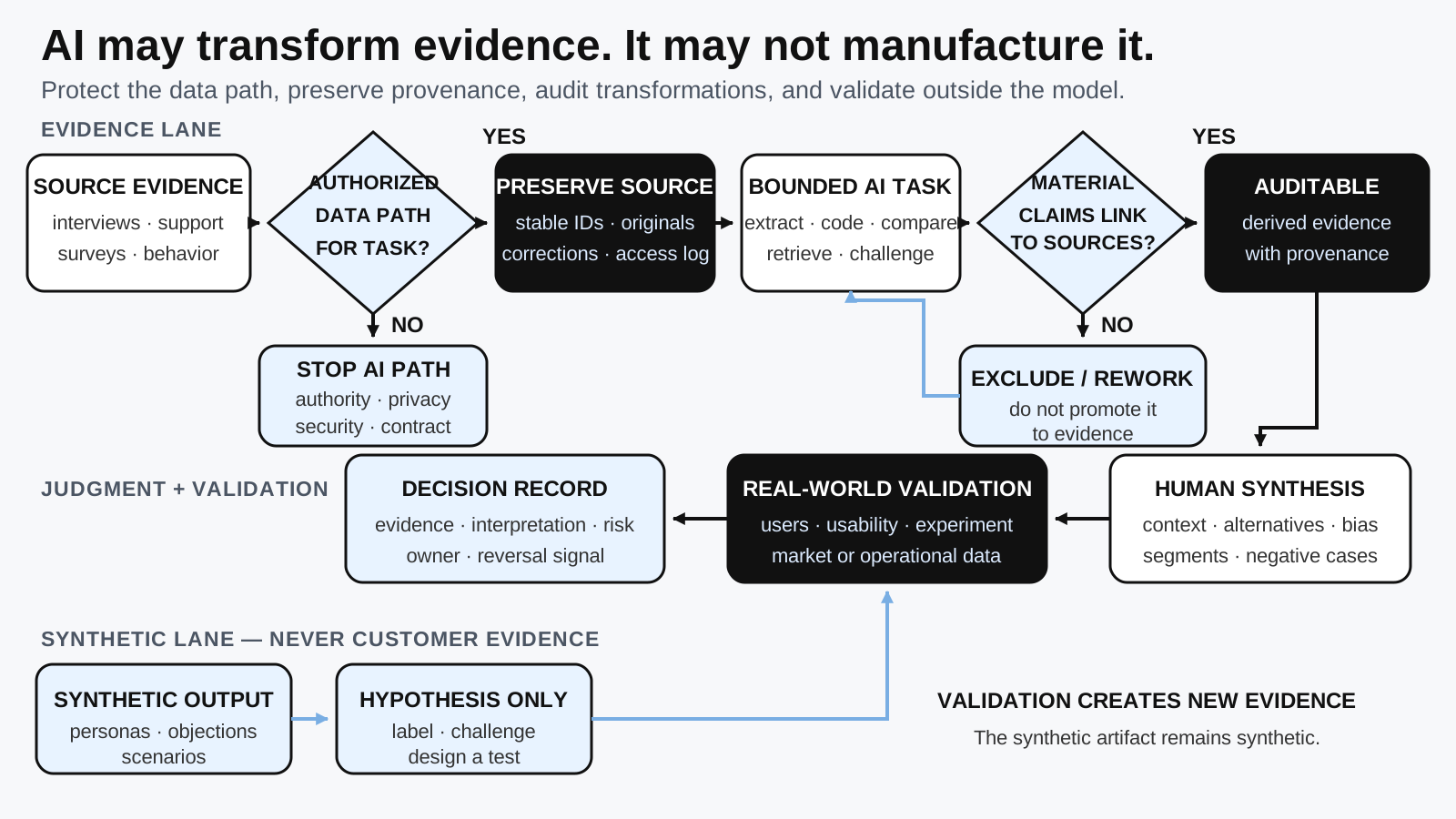
Use AI in product discovery as an evidence-processing assistant, not as a customer substitute. AI can transcribe interviews, retrieve passages, apply a coding scheme, compare segments, identify contradictions, and accelerate prototypes. It cannot create evidence that a customer has a problem, will change behavior, or will buy. Every AI-assisted finding should remain linked to an approved source, method, participant or dataset, and transformation history. Synthetic users can challenge a concept or generate research questions. Their output remains synthetic; validation creates new real-world evidence that may support or reject the hypothesis. Speed is useful only when provenance, privacy, bias, and human judgment survive the acceleration.
Faster synthesis is not more evidence
Product teams can now turn hours of interviews into themes before the meeting room has cooled down. That is impressive. It is also dangerous, because a polished summary feels more certain than the messy source material from which it came.
Discovery evidence is rarely clean. One participant contradicts another. The same word means different things to a user and a buyer. A rare objection may matter more than a frequent preference because the person raising it can block adoption. Tone, hesitation, context, and what was not asked can change interpretation. Compression removes detail by design.
The hard constraint is therefore not model intelligence. It is traceability. If a team cannot move from a product claim back to the source passages, participants, selection method, and analysis decisions behind it, the claim is not decision-ready evidence.
This article extends Data Panda's AI product-management fundamentals. The focus here is different: not how to manage an AI product, but how any product manager can use AI during discovery without losing the boundary between observation and invention.
Separate four levels of knowledge
The team should label discovery material by what it actually is. Do not put interview statements, model summaries, product hypotheses, and synthetic-user reactions into one column called “insights.”
| Level | What belongs here | How it may be used |
|---|---|---|
| Source evidence | Approved recordings, transcripts, notes, support cases, survey responses, usage data, and documented observations | Supports claims within the limits of sampling and method |
| Derived evidence | Codes, extracted passages, counts, clusters, and summaries linked back to source evidence | Accelerates analysis; must remain auditable |
| Interpretation | Human explanation of what the evidence may mean, including assumptions and alternatives | Forms a product hypothesis or recommendation |
| Synthetic output | Model-generated personas, objections, scenarios, responses, or simulated behavior | Generates questions and test cases; does not establish customer truth |
This hierarchy is deliberately conservative. It prevents a language model's fluency from upgrading an idea into a finding.
What research supports—and what this article recommends
Research-supported observations
The NIST AI Risk Management Framework is designed to incorporate trustworthiness considerations into the design, development, use, and evaluation of AI systems. Its core guidance emphasizes documenting intended users, impacts, assumptions, limitations, metrics, and test, evaluation, verification, and validation processes. NIST does not provide a product-discovery recipe, but its govern, map, measure, and manage logic supports a disciplined approach to AI-assisted research.
A 2026 validation preprint on interview-informed generative agents for product discovery compared personalized agents with responses from the people whose interviews informed them. The study reports both potential and limits. It should not be read as proof that an unconstrained generic persona can replace customers, or that results transfer automatically to another domain, population, or decision.
A 2026 study based on manager interviews examined AI and human input in customer-feedback systems. Its published abstract describes AI as useful for high-volume extraction while warning about contextual nuance, and it also notes that human involvement can introduce distortion rather than automatically correcting it. The practical implication is not “trust people” or “trust the model.” It is to design checks for both.
Recommendations from this article
The following workflow is a product-management recommendation derived from those principles and established research practice. It has not been proven as a universal standard:
- Preserve approved source evidence before transformation.
- Require every material AI-derived claim to link back to source passages or records.
- Separate extraction from interpretation.
- Audit negative cases, minority views, and segment differences.
- Use real users or behavioral evidence to validate decisions.
- Keep synthetic output in a visibly separate hypothesis lane.
That distinction matters. Evidence supports a recommendation; it does not make the recommendation inevitable.
Start with privacy and confidentiality, not a prompt
Interview transcripts and support records can contain names, contact information, employer details, account problems, health or financial information, confidential product plans, security issues, and contractual material. Sending them to an AI service is a data-processing decision.
Before using a model, confirm:
- Participants were informed about recording, transcription, analysis, and intended reuse where required
- The organization has approved the tool, account type, region, retention settings, and data-processing terms
- Only the minimum necessary data is provided
- Identifiers and confidential details are removed or masked when possible
- Access is limited and logged appropriately
- Source files, outputs, deletion, and retention have owners
- Legal, privacy, security, and customer-contract requirements have been reviewed for the actual context
The NIST Privacy Framework offers a jurisdiction-agnostic way to manage privacy risk, including policies and capabilities for data access, sharing, retention, review, and deletion. It does not replace the law or contractual terms that apply to a specific research program.
This is not legal advice. Privacy requirements vary by jurisdiction, data type, agreement, and use. Local processing may reduce third-party transmission risk, but it does not itself establish consent, lawful authority, contractual permission, or organizational approval. When approval is unclear, stop the AI path and resolve it; further redaction or manual analysis may reduce exposure but does not cure a missing authority. Discovery speed does not outrank a commitment made to a participant or customer.
Use AI for bounded tasks
AI is strongest when the team defines a transformation that can be checked. Examples include:
- Transcribe a recording, followed by a transcript quality review
- Extract passages relevant to a predefined research question
- Apply a documented coding scheme and return source identifiers
- Compare how named segments discuss the same workflow
- List contradictions, exceptions, and missing information
- Generate alternative interpretations for a human reviewer
- Create prototype variations that real participants can evaluate
These tasks reduce retrieval and organization effort. They do not decide whether a theme is strategically important, whether a participant is representative, or whether the company should build something.
Data Panda's qualitative-versus-quantitative guide is relevant here. AI does not change the underlying method. A model-generated count of interview codes is still based on a small, selected qualitative sample. It does not become a market statistic because software counted it quickly.
The AI discovery control table
| Discovery activity | Acceptable AI role | Required human or method check | Evidence status |
|---|---|---|---|
| Interview transcription | Create a searchable draft transcript | Review material passages; preserve recording and corrections | Source only after quality control |
| Theme coding | Apply a defined codebook and return citations | Audit samples, disagreements, rare cases, and uncoded material | Derived evidence |
| Research synthesis | Organize claims, supporting passages, and contradictions | Researcher evaluates sampling, context, causality, and alternatives | Interpretation |
| Synthetic persona response | Generate objections or edge cases to investigate | Test with real participants or behavior | Hypothesis only |
| Prototype generation | Create variations quickly | Evaluate usability, comprehension, value, and technical feasibility | Artifact, not validation |
| Decision recommendation | Challenge assumptions and summarize trade-offs | Accountable humans examine evidence, risk, and strategy | Decision support, not authority |
Bias enters before and after the model
A biased output may accurately reflect biased source data. If the team interviews only champions, the model will find enthusiasm. If support tickets overrepresent customers with problems, the model will find frustration. If sales notes omit failed deals, the model will explain existing customers rather than the lost market.
Models can add other distortions through training data, prompt framing, retrieval limits, language performance, summarization choices, and a tendency to produce a coherent answer even when evidence is incomplete. Humans add confirmation bias, status incentives, selective attention, and attachment to a preferred roadmap.
Use a bias review that asks:
- Who is represented, missing, overrepresented, or filtered out?
- Who collected the data and for what original purpose?
- Which languages, accessibility needs, roles, regions, or customer outcomes may be handled poorly?
- What evidence contradicts the dominant theme?
- Could the same observations support another explanation?
- Who benefits if the team accepts this interpretation?
The final question is uncomfortable, which is precisely why it is useful.
Synthetic users are rehearsal partners, not respondents
A synthetic persona can be useful for preparing an interview guide, stress-testing language, generating possible objections, exploring accessibility scenarios, or exposing assumptions the team forgot to write down. It is fast, available, and never misses a calendar invitation.
It also has no account to configure, no procurement process, no colleague resisting change, no legacy data to migrate, and no personal consequence if the product fails. Even an agent grounded in real interviews is a model of evidence, not another observation from the market.
Keep synthetic output in a separate workspace labeled “generated hypotheses.” Do not mix synthetic quotations with participant quotations. Do not report the number of simulated agents preferring an option as market demand. If synthetic output changes a roadmap decision, identify the real-world test that must occur before commitment. Even after that test, the synthetic artifact does not become customer evidence; the new observation does.
The site's guides to customer discovery interviews and user-research methods remain the foundation. AI changes the speed and scale of some activities. It does not remove the need to select an appropriate method.
The rare blocker AI summarized away
This is a hypothetical example, not a report of Sergey's experience or a named study. A B2B team interviews ten users about a workflow product. Most participants complain about slow reporting. One technical evaluator raises a security requirement that would prevent deployment. The AI summary correctly identifies reporting speed as the most frequent theme and describes security as a minor concern.
If the team treats frequency as priority, it accelerates the report and loses the purchase. If it returns to roles and decision power, it sees a different structure: reporting affects daily value, while security is a gate. Both matter, but they enter the decision differently.
The product manager revises the synthesis into three layers: recurring user pain, buying-gate requirements, and untested interpretations. Each claim links to source passages and participant roles. The team validates the security condition with additional technical evaluators and then uses a prototype to test whether faster reporting changes user behavior.
AI did not fail. The original analysis question was incomplete. The remedy was better product judgment, source traceability, and follow-up research.
A provenance workflow for a real decision
- Define the decision and research question. State what the team may decide and what evidence would change it.
- Approve the data path. Document sources, consent or other basis, sensitivity, tool, retention, access, and prohibited content.
- Preserve originals. Keep immutable source identifiers and correction history.
- Specify the AI task. Ask for bounded extraction, coding, comparison, or challenge—not “find insights.”
- Require citations. Each material output should identify its source record and passage.
- Audit the transformation. Review samples, high-impact claims, contradictions, minority cases, and model omissions.
- Interpret with context. Separate observation from explanation and list plausible alternatives.
- Validate outside the model. Use follow-up interviews, usability tests, experiments, market behavior, or operational data appropriate to the claim.
- Record the decision. Link evidence, assumptions, risks, owner, and the signal that would trigger reconsideration.
This turns the product hypothesis into something testable, consistent with Data Panda's guide to formulating hypotheses.
Speed without provenance is faster ambiguity
AI can make product discovery more searchable, systematic, and fast. It can also make weak evidence sound finished. The difference is not the sophistication of the prompt. It is whether the team preserves provenance, protects people and confidential data, checks bias, distinguishes extraction from interpretation, and validates important claims in the real world.
Use the model to reduce clerical distance between a product manager and the evidence. Do not use it to remove the customer from customer discovery.
Keep every important claim connected to evidence

Before using an AI-assisted finding, ask where it came from, how it changed, who reviewed it, and what real-world test could disprove it. To discuss a research or product-decision workflow, contact Data Panda.