Traceability prevents a specific kind of product failure
A requirement can pass every test and still disappoint the customer. That is not a contradiction. It usually means the team verified the specification but never validated the product against the original need.
Consider a hypothetical B2B monitoring product with a sensor, embedded firmware, a cloud service, and an operator application. A customer says, “We need to reduce unplanned shutdowns caused by overheating equipment.” During discovery, the team converts that need into an alert feature. The specification says the system shall create an alert within five minutes after a defined temperature condition is detected. Engineering builds it. The test team injects the condition, records the timestamps, and confirms a four-minute response. Verification passes.
At a representative site, however, operators are not allowed to carry phones in the work area. The application sends the alert exactly as specified, but nobody sees it until the next break. The system met the written requirement. It did not meet the operational need.
The missing artifact was not another feature. It was the connection between the need, the operating context, the requirement, and the validation scenario. This is why a product manager should treat traceability as a decision system rather than documentation assembled before a review.
Need, requirement, verification, and validation are different
Teams often use these words interchangeably, then discover the difference during acceptance testing. The distinction is practical:
- Need: the problem or outcome a stakeholder cares about. It describes why a solution is necessary without prescribing the solution.
- Requirement: an agreed, necessary, feasible, and verifiable statement of what the product or system must do or constrain.
- Verification: objective evidence that the realized product meets specified requirements. Testing is one verification method; analysis, inspection, and demonstration may also be appropriate.
- Validation: evidence that the product, used in its intended environment, satisfies stakeholder needs and intended use.
NASA's guidance separates stakeholder needs and expectations from technical requirements and describes a need as the problem the system is supposed to solve, not the solution. Its technical requirements process then transforms agreed expectations into validated, measurable requirements. This is a useful discipline even when the product is a commercial application rather than a spacecraft.
There is one terminology trap. Teams also validate requirements before implementation by checking that they are complete, feasible, consistent, unambiguous, and traceable to stakeholder expectations. In this article, “validation evidence” means product validation: evidence that the realized product satisfies the intended use. Both activities matter, but they answer different questions.
Return to the hypothetical alert
The four artifacts could read as follows:
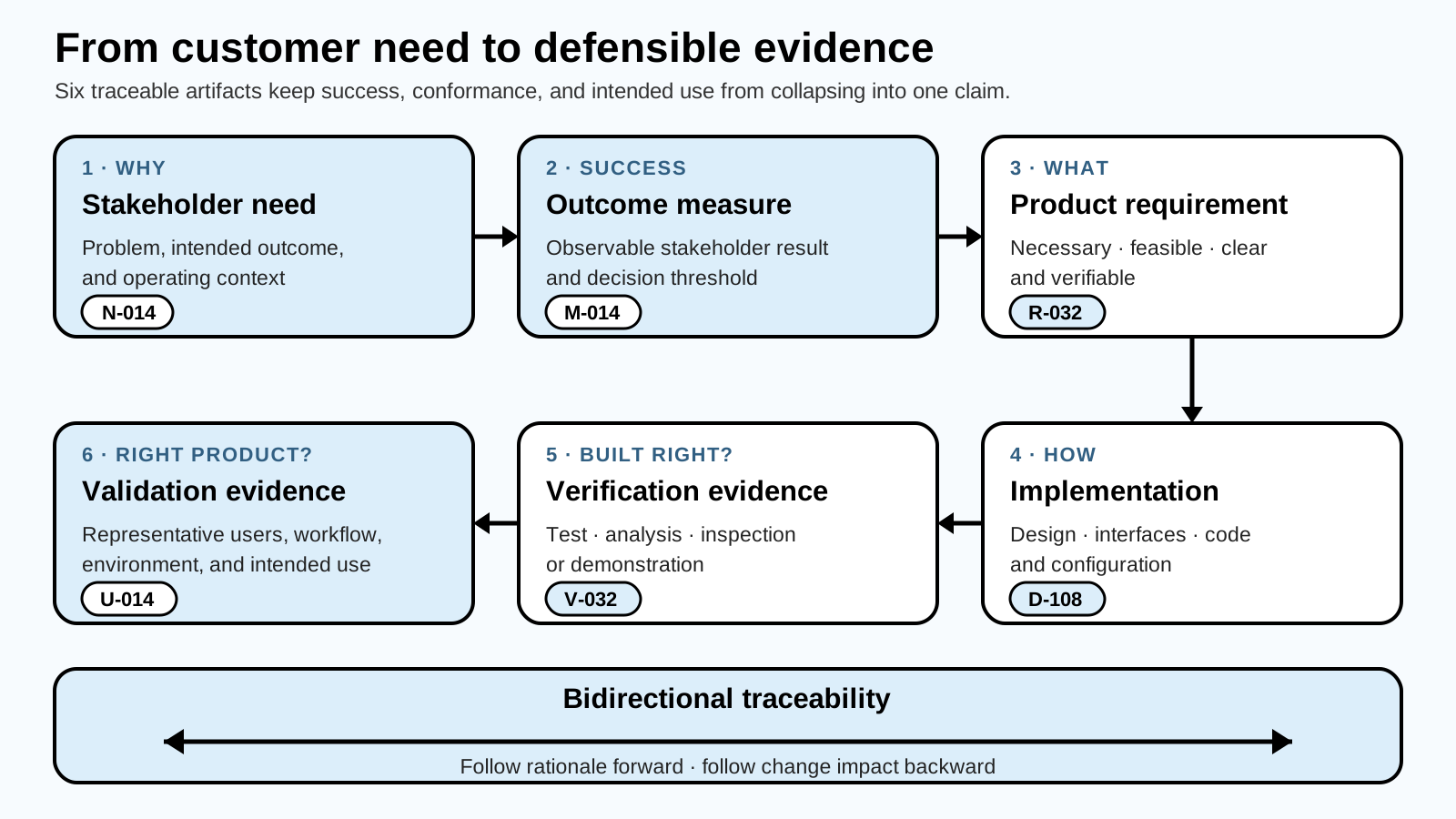
- Need N-014: Operations must reduce shutdowns caused by overheating that is detected too late.
- Requirement R-032: Under the defined sensor, connectivity, and threshold conditions, the system shall notify an authorized operator within five minutes of detecting an overtemperature event.
- Verification V-032: A controlled end-to-end test records detection and notification timestamps across the supported device, firmware, network, and application versions.
- Validation U-014: Representative operators receive, understand, and can act on the notification within the operating environment and escalation procedure.
The requirement is still not complete until the team defines the supported conditions, acceptance threshold, responsible recipient, and evidence source. “Send alerts quickly” is an intention. It is not a verifiable product requirement.
Build a traceability chain, not a document warehouse
A practical chain is bidirectional:
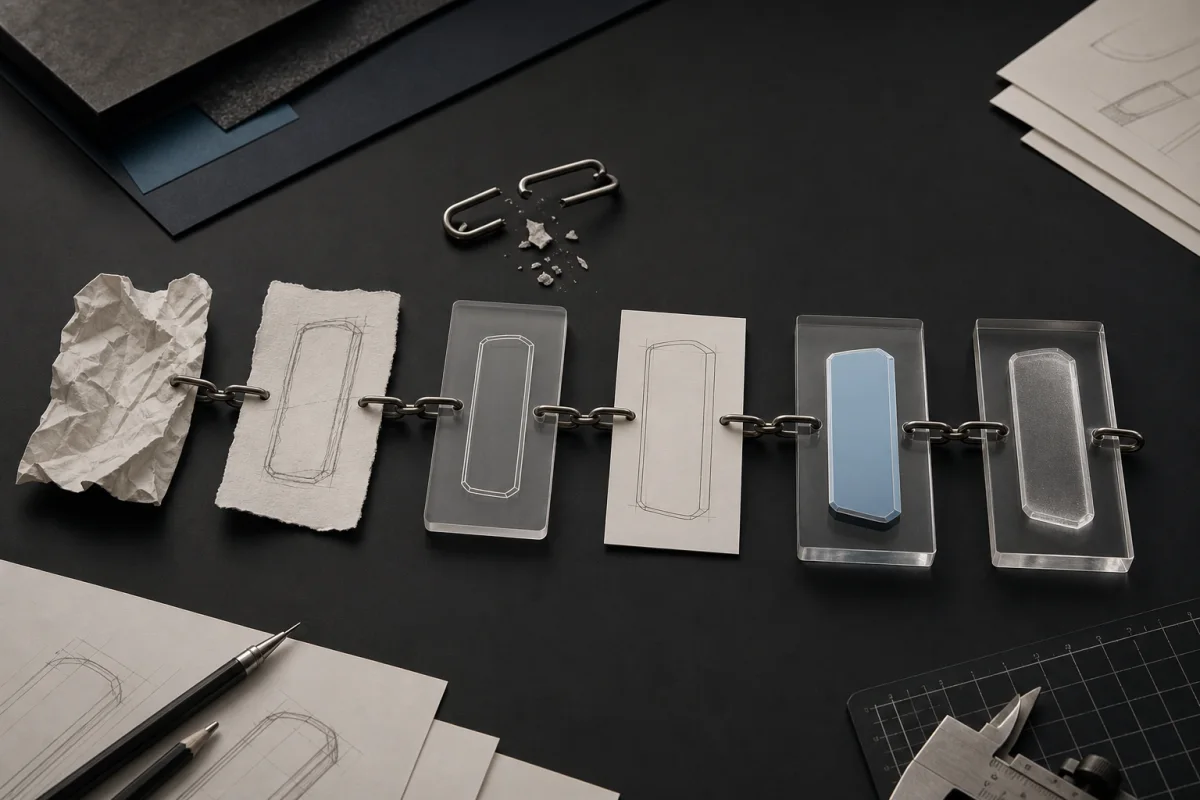
Stakeholder need ↔ outcome measure ↔ product requirement ↔ design or implementation artifact ↔ verification method and result ↔ validation scenario and result.
Forward links show whether the team implemented and evaluated everything it agreed to deliver. Backward links show whether every feature, test, and design constraint has a reason to exist. NASA's requirements-management guidance explicitly calls for bidirectional traceability between expectations, requirements, design documents, and test plans and procedures.
This does not mean every product needs an expensive requirements platform. A controlled spreadsheet, database, issue tracker, or model can work if the identifiers and relationships survive changes. The tool is secondary. The operating habit is the product.
The minimum record for each important requirement
For a reversible interface detail, a user story and acceptance criteria may be enough. For a costly, contractual, safety-related, or cross-system requirement, record at least:
- a stable identifier and concise statement;
- the parent need, source, and rationale;
- the stakeholder or decision owner;
- assumptions, constraints, and affected interfaces;
- acceptance criteria and planned verification method;
- links to design, implementation, and test artifacts;
- verification status, result, and exceptions;
- the intended-use validation scenario and outcome;
- change history, approved deviations, and review date.
If the team cannot state the source and rationale, ask whether the requirement is necessary. If it cannot state a verification method, the wording is probably not ready. NASA's checklist for writing good requirements recommends one thought per requirement, active language, measurable tolerances where relevant, and freedom from unnecessary implementation detail.
A decision table for product managers
| Question | Artifact to inspect | What a gap means | Product action |
|---|---|---|---|
| Why does this exist? | Parent need, discovery evidence, rationale | Possible solution looking for a problem | Clarify, merge, or remove before committing cost |
| What exactly must be true? | Requirement and acceptance conditions | Different teams can implement different interpretations | Resolve ambiguity with engineering, design, and the stakeholder |
| How will we prove conformance? | Verification method, environment, result | Requirement may be untestable or evidence may not cover supported conditions | Define evidence before implementation is complete |
| Will it solve the operating problem? | Validation scenario with representative users and context | A compliant product may still fail in use | Test the workflow, not only the component |
| What breaks if this changes? | Backward and forward links | Impact is hidden across teams or releases | Review affected design, tests, interfaces, contracts, and training |
Where the product manager should lead
The product manager should not write every subsystem requirement or decide the engineering verification method alone. Engineering, quality, security, design, operations, and test specialists own essential parts of the diagnosis. The product role is to protect the connection to value and make the unresolved trade-offs visible.
That starts in discovery. A customer discovery interview produces observations and needs, not ready-made requirements. The team still has to interpret what it heard, examine contradictions, and decide which outcomes matter. The common mistakes in requirements gathering are particularly expensive when an enthusiastic stakeholder's preferred solution is recorded as if it were the underlying need.
From there, the product manager should:
- Confirm the need and operating context with the affected stakeholders.
- Separate outcome, constraint, and proposed solution.
- Agree on priority and decision authority when needs conflict.
- Ask engineering and test owners how conformance can be demonstrated.
- Define how the team will validate the complete user or operator workflow.
- Review traceability when scope, interfaces, assumptions, or acceptance evidence changes.
User stories can express user context and value, while detailed product or system requirements define critical behavior and constraints. Neither format replaces the other automatically. When a story becomes too broad, breaking it into smaller slices should preserve the links to the same outcome rather than create disconnected backlog fragments.
Use rigor in proportion to the cost of being wrong
A medical device, financial control, industrial safety function, or contractual performance guarantee needs stronger baselines and evidence than a reversible copy change. FDA's current Special 510(k) guidance page makes the distinction concrete: verification checks that design outputs meet design inputs, while validation checks that the device conforms to defined user needs and intended uses. The medical-device context is domain-specific, but the logical separation is broadly useful.
Proportionality does not mean skipping the chain for ordinary software. It means matching the record to exposure. A small team may trace only its critical journeys, contractual requirements, security controls, data rules, and expensive dependencies. A regulated or safety-related program may need controlled baselines, formal reviews, signed evidence, and traceability through hazards and mitigations.
My judgment would change with four pieces of evidence: the change is cheap and fully reversible; no external contract or interface depends on it; failure has limited user or business impact; and telemetry can reveal the result quickly. When those conditions are true, a lighter record is reasonable. When they are not, “we all understand the requirement” is not a control.
Inspect the chain before the team commits
- Can every critical requirement point backward to a stakeholder need or approved constraint?
- Can every need point forward to one or more delivery and evidence artifacts?
- Is each requirement necessary, feasible, unambiguous, and verifiable?
- Are assumptions and supported operating conditions explicit?
- Is the verification method defined before the work is considered complete?
- Does validation use representative users, workflows, environments, and interfaces?
- Are failed results, waivers, and accepted deviations visible?
- When something changes, can the team identify affected design, code, tests, documentation, training, and contracts?
The matrix is not the goal. The goal is to prevent a team from proving, with impressive evidence, that it built the wrong thing correctly.
Make complex requirements easier to defend

If your product spans customers, engineering teams, suppliers, and test evidence, contact Sergey for an independent review of the decision chain.