

To sunset a product without breaking customer trust, treat retirement as a managed customer transition rather than a shutdown date. First establish why continued support is no longer responsible. Then define the affected products, versions, customers, contracts, data, security commitments, physical-service obligations, and replacement paths. Communicate what changes, when it changes, why it changes, and what each customer can do next. Measure migration and unresolved risk before declaring success. A clean end-of-life decision is not the moment the company stops developing the old product; it is the point when customers can leave it without being abandoned.
Every product has more than one ending
A product can stop accepting new customers while existing customers still use it. Feature development can end while security updates continue. Manufacturing can stop while spare parts and field service remain. A cloud service can be retired while customer data must still be exported or retained. “End of life” sounds like one event, but product managers usually manage a sequence of commitments.
This is why a sunset is easy to announce and difficult to complete. Finance sees a declining revenue line. Engineering sees an old architecture. Sales sees renewal risk. Support sees customers who still depend on the product every day. Operations sees inventory, tools, and trained people. Customers see a promise they planned around.
The hidden constraint is often not technology. It is the distance between what the company thinks it sold and what customers believe they bought.
Why a product that still works may need to end
Sunsetting is justified when keeping the product creates more customer and business risk than moving away from it. Common signals include:
- Usage and revenue no longer support responsible maintenance
- The product cannot meet current security, reliability, privacy, or compliance expectations
- Critical components, suppliers, platforms, or specialist skills are disappearing
- A replacement delivers materially better outcomes and maintaining both fragments investment
- Support effort is rising while customer value is falling
- The product no longer fits the company's strategy or channel model
No single signal is sufficient by itself. A low-revenue product may be essential to a strategic account. A technically old product may be stable and inexpensive to support. A replacement may look better in a demo but lack migration, integrations, reporting, or field-service coverage. Product lifecycle decisions require the same broad view described in Data Panda's product-management approach: customer value, business logic, technical reality, and execution must agree.
Separate the decision from the transition
The organization first decides whether to continue, constrain, replace, or retire the product. It then designs the transition. Mixing these conversations creates confusion. Teams argue about the wording of an announcement while the actual decision remains untested.
| Path | Use when | Product commitment |
|---|---|---|
| Renew | The product remains valuable and strategically viable | Invest, modernize, and set measurable recovery outcomes |
| Contain | Customers still depend on it, but expansion would increase risk | Stop new scope; maintain defined support while preparing migration |
| Migrate | A credible replacement exists and customer value can be preserved | Fund tooling, support, incentives, and compatibility work |
| Retire | Mandatory obligations are resolved; residual discretionary risk is accepted by named accountable owners | End operation or support according to the published plan |
The table prevents “sunset” from becoming a euphemism for starving a product until customers give up. Containment is a deliberate state with an owner, scope, support level, and exit condition.
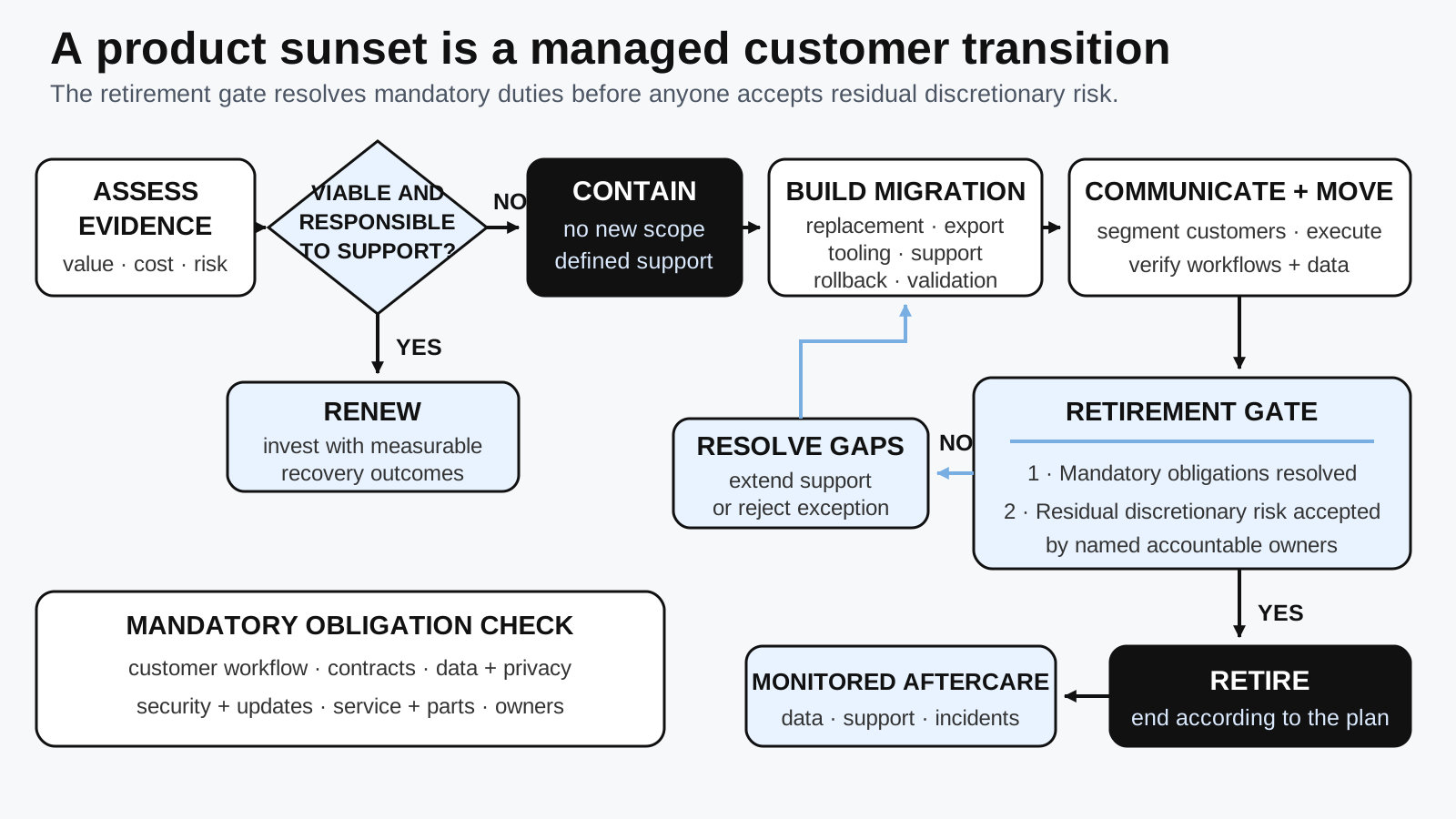
Build the obligation map before choosing a date
A product manager should create one inventory that shows what retirement means across functions. This is not legal advice, and legal or regulatory obligations must be reviewed by qualified counsel in the relevant jurisdictions. Non-waivable legal, contractual, safety, security, and data duties cannot be converted into “accepted risk” by an internal decision. The checklist is a product-operating tool designed to reveal missing work, not to decide which obligations can be waived.
Customer and workflow obligations
- Which users, accounts, regions, and workflows still depend on the product?
- What business process stops if the product disappears?
- Which integrations, reports, automations, and trained behaviors must move?
- Are accessible migration support and documentation available for every affected segment?
Commercial and contractual obligations
- What do active contracts, warranties, service agreements, and channel commitments require?
- Which renewals, prepaid periods, credits, or pricing protections are affected?
- Who has authority to approve exceptions, extensions, or customer-specific remedies?
Security, privacy, and data obligations
- How long will vulnerabilities be monitored and patched?
- What happens to authentication, certificates, keys, and connected services?
- How can customers export, transfer, or delete their data?
- What records must be retained, and who can access them after retirement?
NIST's IoT cybersecurity guidance explicitly treats product support as a lifecycle spanning pre-market through post-market activity and end of life. Its 2026 update emphasizes communication with customers about maintenance, support, and end-of-life expectations. That is particularly relevant to connected physical products, where software retirement can affect a device that remains in service. See the NIST IR 8259 Rev. 1.
Physical-product and service obligations
- How many units remain installed, in inventory, with distributors, or in repair loops?
- Are spare parts, replacement units, tools, manuals, and trained technicians available?
- Are component obsolescence, safe disposal, take-back, and recycling addressed?
- Can firmware and configuration support continue safely after manufacturing stops?
Internal operating obligations
- Who owns the product after the original team moves on?
- Which dashboards, support queues, supplier relationships, and escalation paths must remain?
- What institutional knowledge must be documented before specialists leave?
- What is the budget for migration and tail support?
If the obligation map has blank owners, the product is not ready for a retirement date. It is only ready for a meeting.
A controller can outlive its cloud
This is a hypothetical case, not a description of Sergey's work or a named company. A manufacturer sells a connected controller with embedded firmware and a cloud dashboard. A newer generation is easier to secure and support, but hundreds of older units remain in customer facilities. Manufacturing has stopped, yet some customers have service agreements and depend on historical dashboard data.
The first proposal is to switch off the old cloud environment once the final sales contract ends. Engineering correctly notes that the platform is costly. Finance correctly notes that the installed base is shrinking. Both statements are incomplete.
The obligation map reveals four hidden dependencies: some customers need a hardware gateway before the new cloud service can read old units; field technicians need updated procedures; customers require a verified data export; and a subset of devices cannot receive the planned security update without an on-site visit.
The product team chooses containment before retirement. It stops new activations, limits changes to security and critical reliability work, publishes supported configurations, develops the gateway and export tools, and segments customers by migration complexity. The final shutdown gate requires mandatory obligations to be resolved. Any remaining discretionary exception must be documented, time-bounded, and accepted by a named accountable owner—not hidden behind elapsed time.
The old product still ends. The difference is that customers experience a transition with evidence, choices, and accountable owners rather than a surprise.
Design the migration as a product
Migration has users, failure modes, metrics, and a journey. It deserves product work. A replacement is not ready merely because it can perform the old product's headline function.
Map the transition from the customer's perspective:
- Understand: Can the customer identify affected products, dates, and consequences?
- Choose: Are replacement, export, extended-support, or exit options clear?
- Prepare: Can the customer assess integrations, training, downtime, cost, and approvals?
- Move: Are tools, documentation, support, rollback, and validation available?
- Confirm: Can both sides verify that data, workflows, permissions, and expected outcomes survived?
- Close: Does the customer know what remains accessible and where support now lives?
This is where the software shipping cycle meets product lifecycle management: release planning must include rollback, observability, compatibility, and operational ownership. For physical products, it also meets Lean manufacturing through inventory, service, parts, and process control.
Communicate in layers, not in one dramatic email
A credible communication plan has several audiences and repeated contact. Internal customer-facing teams need the plan, rationale, boundaries, and escalation process before external notification. Strategic customers may need direct discussion. Administrators need technical steps. Users need workflow guidance. Procurement and legal contacts may need formal notices through agreed channels.
Each communication should answer:
- What product, version, feature, service, or region is affected?
- What stops and what continues at each milestone?
- Why is the change being made, in language that does not insult customers who still rely on it?
- What replacement, migration, export, support, or exception paths exist?
- What action is required, by whom, and by when?
- Where can the customer verify status and get help?
Do not promise “seamless migration” unless it has been demonstrated for the customer's configuration. Describe known constraints. Trust grows when a company tells the truth early enough for customers to plan.
Public lifecycle programs demonstrate the value of explicit stages and dates. Microsoft's product lifecycle documentation separates support milestones and publishes product-specific schedules. AWS similarly keeps a public list of services in sunset with migration direction. These programs are not templates for every business, but they show that retirement information should be findable after the announcement email disappears.
Measure transition risk, not announcement completion
The sunset dashboard should show whether customers and obligations are moving, not whether internal tasks have green check marks. Useful measures include:
- Affected accounts identified and contacted
- Customer acknowledgment and chosen path
- Migration eligibility, scheduled migrations, completions, failures, and rollbacks
- Critical workflows and integrations validated after migration
- Unresolved contractual, data, security, support, and physical-service obligations
- Installed units or active instances by risk segment
- Exceptions, owners, expiration dates, and accepted residual risk
- Support volume and customer sentiment during the transition
Use leading and lagging measures together, consistent with Data Panda's discussion of product indicators. Migration bookings and readiness checks lead. Completed moves, incidents, churn, and unresolved claims lag. One cannot substitute for the other.
Know when to delay—and when not to
A delay may be responsible when the replacement is unsafe, data export fails, contractual analysis is incomplete, critical customer workflows cannot migrate, or support coverage is not ready. A delay is not automatically responsible when the only reason is discomfort with a difficult conversation.
Conversely, a small number of remaining users does not automatically justify immediate retirement. The severity of their dependency matters. The right decision compares the cost and risk of extension with the cost and risk imposed on customers.
Forrester's public summary of its sunset communication-plan model emphasizes preserving customer relationships and company revenue while managing end of life. That framing is useful because it treats retirement as product and commercial work rather than a purely technical cleanup. See The Forrester PMM Model: Sunset Communication Plan.
The date is not the gate
A trustworthy sunset has a defensible reason, a complete obligation map, a funded migration product, clear communications, and a retirement gate based on evidence. The gate resolves mandatory duties before separating any genuinely discretionary residual risk for explicit acceptance by named owners. It also distinguishes the last sale, last feature, last security update, last supported use, and final shutdown.
Customers do not expect every product to live forever. They do expect the company to remember that a product can remain part of their operations long after it disappears from the roadmap. End the product if that is the responsible choice. Do not end the relationship by pretending the consequences belong only to the customer.
A sunset plan is a customer plan

Start with the obligation map, give every unresolved item an owner, and make retirement conditional on customer and operational readiness. For help reviewing a complex product transition, contact Data Panda.