A roadmap can be green while the product is not ready
Imagine a hypothetical commercial refrigeration monitoring product. A new sensor board detects early signs of compressor trouble. Firmware reads the signal. A cloud model turns it into an alert. A mobile application gives a technician the recommended action.
The cloud team reports that its service is complete. The application team has a polished screen in beta. The firmware works on engineering samples. The hardware team is still investigating a component substitution and has not completed qualification of the production configuration. Marketing sees four workstreams at 80 or 90 percent and calls the feature nearly ready.
The customer has a simpler measurement: zero percent. There is no supported product combination to install.
This is the hidden problem in a single feature roadmap. It tracks the progress of parts but can obscure whether a known hardware, firmware, cloud, and application set works together, can be deployed safely, and can be supported in the field.
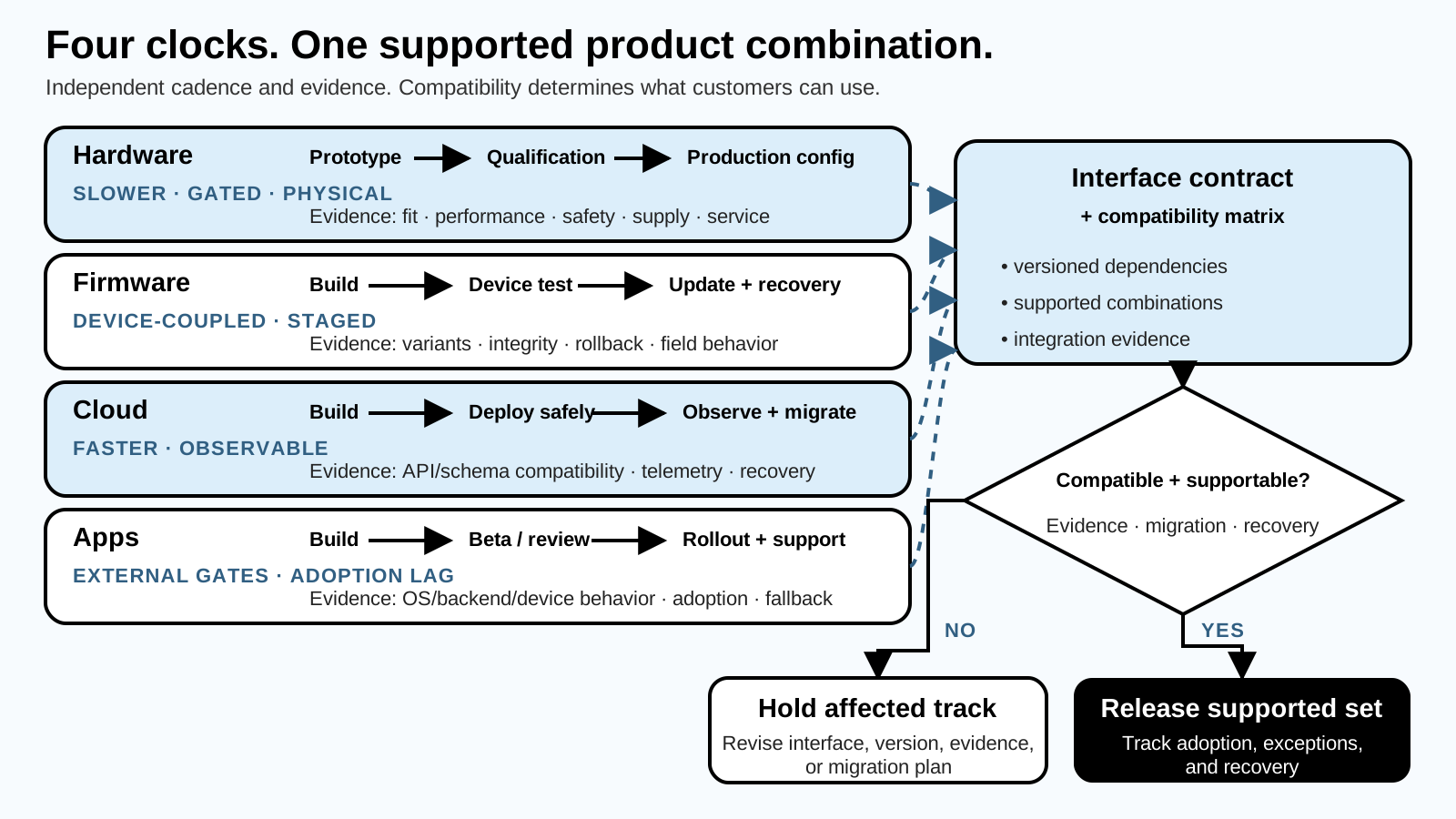
The “four clocks” model
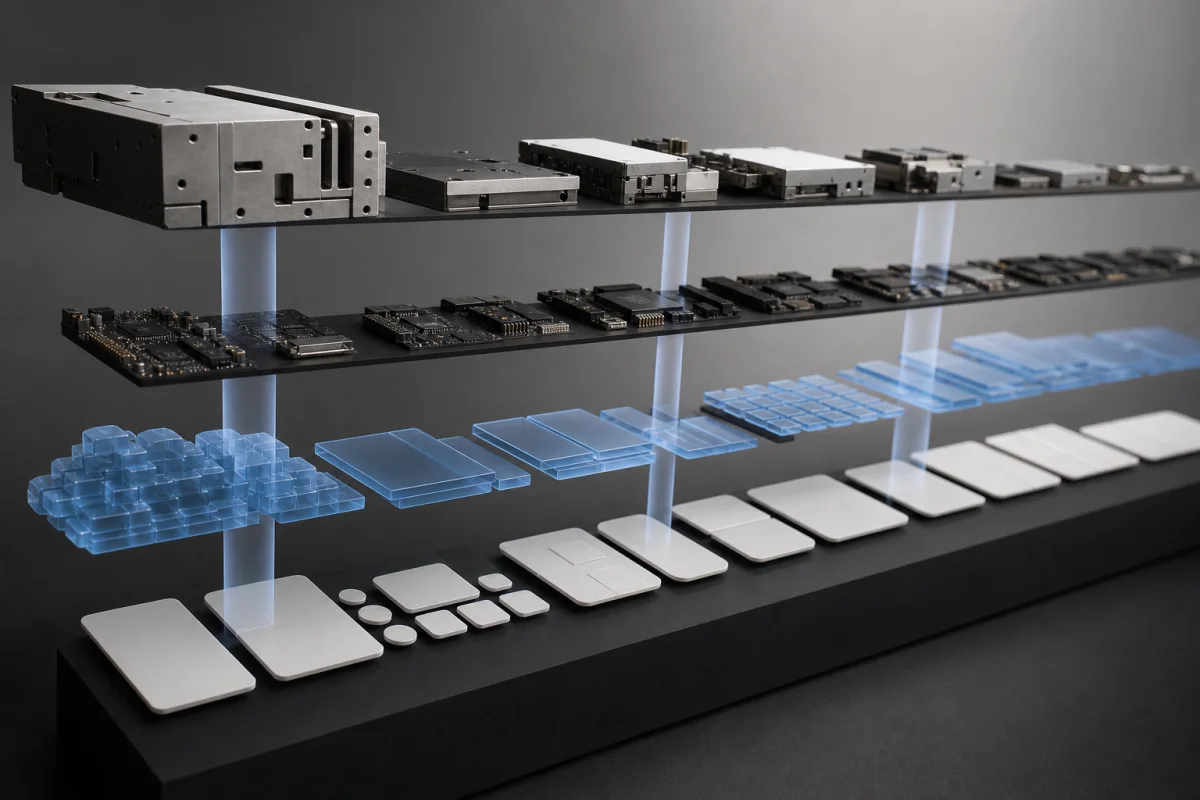
The four clocks are an editorial planning model, not a formal industry standard. The idea is straightforward: each product layer has its own development and release constraints, while the customer experiences their combination as one product.
ISO/IEC/IEEE 15288:2023 applies life-cycle processes iteratively, concurrently, and recursively across systems and system elements. It also avoids prescribing one universal life-cycle model. That is a useful foundation for thinking about mixed products: coordination does not require identical cadence. See the official ISO overview.
Clock 1: hardware
Hardware decisions become physical commitments. A board revision may involve component availability, thermal or mechanical limits, electromagnetic compatibility, safety or industry certification, tooling, manufacturing tests, supplier lead times, inventory, and service procedures. A change may be easy in a prototype and expensive after material is ordered.
The hardware roadmap should therefore expose configuration milestones, not only feature dates:
- architecture and critical-component decisions;
- prototype and engineering-sample availability;
- design reviews and interface baselines;
- verification, qualification, and certification evidence;
- production release, supplier readiness, and service documentation;
- transition and end-of-support plans for previous variants.
This does not mean hardware must always move slowly. It means its speed is bounded by different evidence and reversibility than a cloud deployment.
Clock 2: firmware
Firmware sits in an uncomfortable place. It behaves like software but operates inside physical constraints. It may need to support several processor, board, sensor, memory, or bootloader variants. It also needs a trustworthy update and recovery path, especially when a failed update can leave equipment unavailable in the field.
NIST's Platform Firmware Resiliency Guidelines organize firmware resilience around protecting against unauthorized changes, detecting changes, and recovering securely. Not every connected product falls within that document's platform scope, but the product lesson travels well: “we can update it later” is not a roadmap strategy unless update integrity, compatibility, and recovery are engineered and verified.
Clock 3: cloud services
Cloud teams can often deploy and observe changes faster, but speed creates a support obligation. A service may receive messages from devices that have not updated, expose APIs to old application versions, and process data whose schema changed across firmware generations.
The cloud roadmap should show API and event-schema versions, migration windows, feature flags, observability, rollback or roll-forward options, data backfills, and deprecation dates. Semantic Versioning is one convention for communicating changes to a public API: major versions signal incompatible changes, while minor and patch versions preserve compatibility under the specification. The Semantic Versioning 2.0.0 specification is useful when its assumptions fit, but version numbers do not replace compatibility tests or a support policy.
Clock 4: applications
A web application controlled by the company may deploy with the cloud. A desktop or mobile application may not. Store review, staged distribution, operating-system compatibility, enterprise device management, customer change controls, and simple user reluctance can keep old versions active.
An application roadmap therefore needs a minimum supported backend, device, and operating-system policy. It also needs behavior for partial availability. What should an old application show when a new device capability exists? What should a new application do when it connects to old firmware? Hiding the button may be safer than showing a control that cannot work, but that is a product decision—not a last-minute error message.
Roadmap the interfaces before the dates
A multi-track roadmap becomes useful when it names the dependencies that can invalidate a date. NASA describes interface management as a way to define and maintain compliance among products that must interoperate, especially when development is divided among parties.
For a commercial product, the controlled interface set may include:
- mechanical dimensions, connectors, power, and environmental limits;
- register maps, device drivers, bootloader behavior, and update packages;
- protocols, commands, timing, error handling, and security credentials;
- API contracts, event schemas, units, timestamps, and data-retention rules;
- application permissions, feature flags, roles, and customer configuration;
- manufacturing, provisioning, installation, commissioning, and service workflows.
Do not freeze every internal detail. Freeze what another track, supplier, test environment, or customer workflow depends on. Each interface needs an owner, version, change authority, consumers, and evidence that the supported sides still work together.
The compatibility matrix is a product artifact
A roadmap says what each team intends to deliver. A compatibility matrix says which combinations the company will sell, deploy, update, and support.
Here is a compact example for the hypothetical monitoring product:
| Combination | Product status | Required evidence | Customer treatment |
|---|---|---|---|
| Hardware H1 + firmware F3 + cloud C2 + app A5 | Current supported baseline | Regression and field-support history | Normal support |
| H1 + F4 + C2 + A5 | Conditionally supported | Device update, recovery, and old-app behavior | New sensor feature remains unavailable |
| H2 + F4 + C2 + A6 | Launch candidate | Qualification plus end-to-end workflow validation | Controlled rollout before general availability |
| H2 + F3 | Unsupported | No compatible sensor mapping | Block provisioning or require firmware update |
The identifiers are hypothetical. The important point is that support status belongs to a combination, not to four independent “done” labels.
Use integration windows, not forced synchronization
Four clocks do not mean four isolated roadmaps. They meet at deliberate integration windows:
- Interface review: confirm versions, assumptions, owners, and unresolved changes before teams build against different interpretations.
- Thin end-to-end slice: move one real signal or user action through representative hardware, firmware, cloud, and application components early.
- Configuration build: assemble a named set of versions and record how it was provisioned.
- System verification: confirm the integrated set meets allocated requirements under declared conditions.
- Workflow validation: confirm representative users can achieve the intended outcome in the real operating context.
- Launch and support window: stage availability, observe behavior, manage exceptions, and retain a recovery route.
The tracks do not all have to release at an integration window. The cloud can deploy compatible infrastructure behind a flag. An application can ship support before a hardware feature is enabled. Firmware can roll out in stages. Hardware may enter production while later cloud improvements continue. The gate decides compatibility and exposure, not ceremonial simultaneity.
The same logic complements the software shipping cycle, but mixed products require additional configuration and field evidence. Agile frameworks help teams manage iterative work; they do not remove supplier lead times, qualification, store gates, or installed-base compatibility. An MVP can reduce scope, but it still needs a coherent supported configuration.
Five roadmap views a product manager needs
| View | Question answered | Minimum content |
|---|---|---|
| Outcome roadmap | What customer or business change are we pursuing? | Outcome, evidence, target segment, assumptions |
| Track roadmaps | What must each layer prove independently? | Milestones, decisions, evidence, owner, uncertainty |
| Dependency and interface map | What must remain compatible? | Contract, version, producer, consumer, change authority |
| Compatibility matrix | Which combinations will we support? | Configuration, status, evidence, limitations, expiry |
| Release and migration plan | How will customers move safely? | Sequence, cohort, monitoring, fallback, support communication |
Estimates still matter, but they should reveal uncertainty. The estimation techniques guide is more useful when each estimate names its assumptions and dependency. A precise cloud date attached to an unstable sensor interface is decoration.
What would change the model?
I would simplify the four-clock approach when the tracks are not genuinely independent—for example, a local appliance with fixed firmware and no cloud or application. I would strengthen it when safety, cybersecurity, regulation, long field life, third-party integrations, or contractual availability make an unsupported combination expensive.
The lean manufacturing perspective also changes the decision. Extra configuration variants create inventory, testing, documentation, and service work. Supporting every theoretically possible combination may feel customer-friendly while quietly producing waste and operational risk.
Before the next cross-layer roadmap review
- Does each track have its own exit evidence rather than a shared percentage complete?
- Are physical, protocol, data, API, security, and workflow interfaces versioned and owned?
- Is there a maintained compatibility matrix for current and launch configurations?
- Can older devices, firmware, services, and applications fail safely when a capability is unavailable?
- Are update, migration, observability, and recovery paths part of the product decision?
- Do integration windows start before all tracks claim completion?
- Does the launch plan describe a supported combination and customer migration—not just a feature date?
- Are unsupported combinations blocked, detected, or communicated?
One product does not need one clock. It needs one accountable decision about which versions work together.
Align the product without flattening its complexity

If your roadmap spans hardware, firmware, cloud services, applications, and suppliers, contact Sergey for an independent product-architecture and roadmap review.