

Build, buy, or partner is a product-strategy decision, not a procurement shortcut. The right choice depends on whether the capability creates meaningful differentiation, how quickly the team must learn, what must remain under its control, and who will carry the integration and support burden after launch. A purchased component can be fast but constraining. A custom build can be flexible but consume years of attention. A partner can add expertise while introducing a dependency. The useful question is not, ‘Which option is cheapest today?’ It is, ‘Which option gives this product the best risk-adjusted path to customer value over its working life?’
The false comfort of a binary decision
Build-versus-buy conversations often begin after the team has already chosen a favorite. Engineering wants to build because the problem is interesting. Finance wants to buy because the quote is visible. Sales wants a partner because a customer needs the capability this quarter. Product is then asked to convert three preferences into one apparently objective spreadsheet.
The accounting mismatch is that the options are not symmetrical. A vendor quote exposes subscription and implementation costs, while an internal estimate usually exposes only development effort. The quote may hide migration, integration, and exit costs. The internal estimate may hide maintenance, on-call support, security work, documentation, and the opportunity cost of the roadmap items that will not be built. A partnership may hide commercial constraints or a dependency on another company's priorities.
A 2026 research preprint on enterprise software decisions argues for making strategic, technical, cost, and risk factors explicit so the rationale can be compared and revisited. That is a useful principle even if a team never adopts the paper's specific decision-support model. The output should not be an oracle. It should be an auditable argument. See Misra and colleagues' structured build-versus-buy approach.
Start with the product boundary
Before comparing options, define the capability narrowly enough to evaluate. “Build support operations” is not a decision. It is a continent. The actual choice may be whether to buy a service-desk and search layer, build company-specific routing and escalation rules, keep an existing knowledge store, or ask an implementation partner to manage migration and change.
A useful boundary answers five questions:
- Whose problem is being solved? Name the user, buyer, operator, or internal team.
- What outcome must change? Describe the decision or workflow that becomes better, not merely the component delivered.
- What is genuinely differentiating? Connect the choice to the product's value proposition.
- What must connect to it? List data, interfaces, devices, processes, and teams.
- What is outside the decision? State what the team will not build, buy, or delegate.
This boundary prevents a common failure: comparing a complete vendor product with an optimistic internal prototype. The alternatives must solve the same defined problem at the same operational level.
Four legitimate options, not two
Build
Build when the capability is central to why customers choose the product, when control over behavior or data is strategically important, or when available products cannot meet a necessary constraint. Building can also be the best learning mechanism when the team does not yet understand the problem well enough to specify a durable external dependency.
But “we can build it” is not the same as “we should own it.” Every internal capability creates a future constituency: customers who depend on it, engineers who maintain it, support teams who diagnose it, and managers who must fund its next version.
Buy
Buy when the capability is mature, broadly available, and not a meaningful source of differentiation. Identity management, payments, observability, commodity hardware, or content delivery may fall into this category, depending on the product. Buying can compress time to value and transfer some specialist work to a supplier.
The constraint is that the team buys the vendor's abstraction, roadmap, service levels, and commercial behavior together with the feature. The product manager must evaluate the whole operating relationship, not only the demo.
Partner
Partner when value depends on expertise, access, distribution, service capacity, certification, data, or customer relationships that neither a build nor a standard purchase provides. A partner can co-develop, operate, integrate, manufacture, or take market responsibility for part of the offer.
Partnership is not a friendly synonym for buying. It needs aligned incentives, decision rights, escalation paths, and an answer to what happens when priorities diverge.
Combine
Many strong decisions are hybrid. The team may buy infrastructure, partner for implementation, and build the differentiating workflow. The purpose of decomposition is to own the layer where product advantage is created without volunteering to own every supporting layer beneath it.
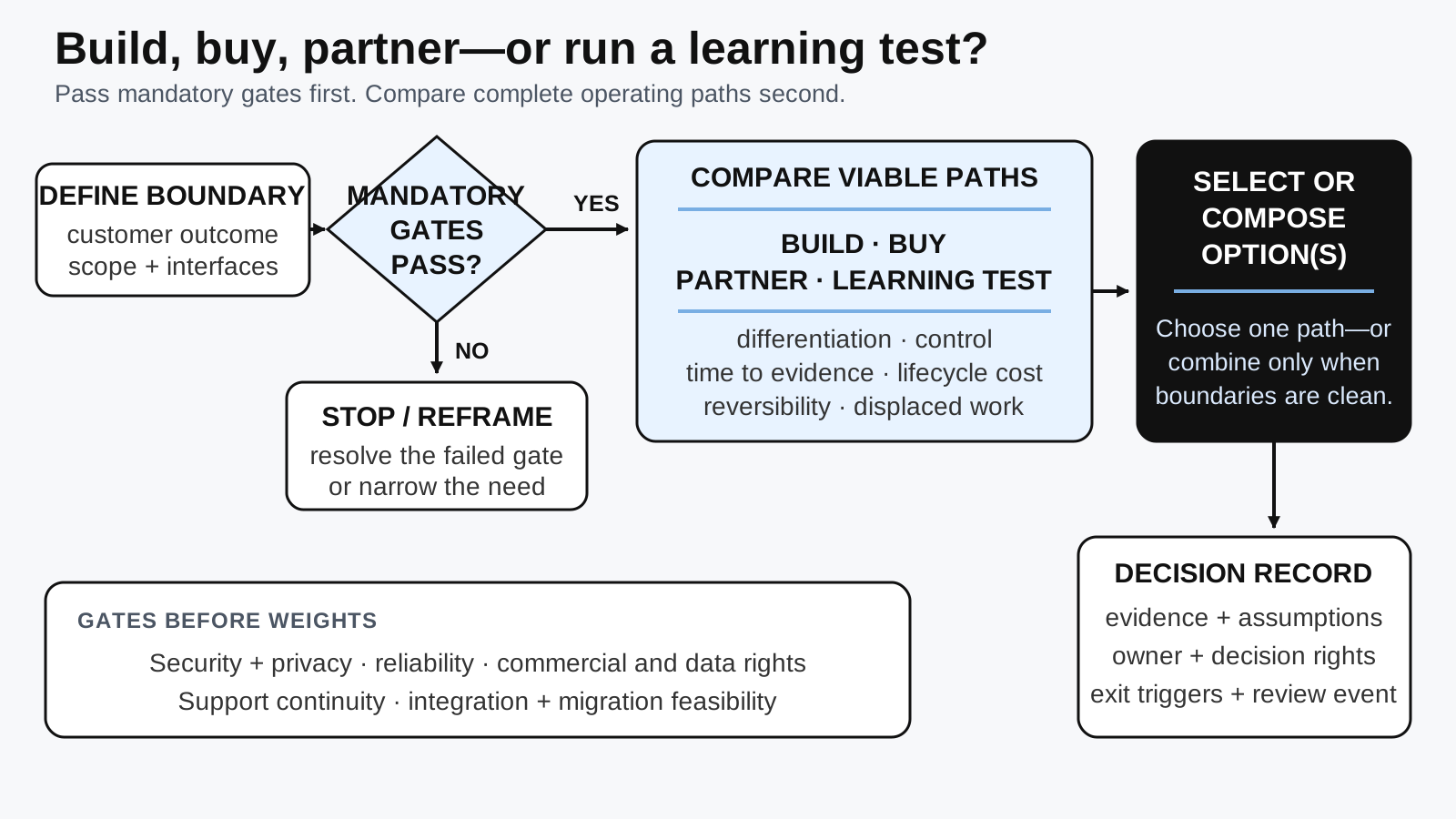
The seven-question decision table
Use the table to expose the trade-offs. Score each option from one to five only after the team writes the evidence behind the score. A number without a note is merely confidence wearing a tie.
| Decision question | Evidence to collect | Usually favors |
|---|---|---|
| Does this capability materially differentiate the product? | Win/loss evidence, customer interviews, willingness to switch or pay | Build or a tightly controlled partnership |
| How quickly must we learn or deliver? | Customer deadline, cost of delay, experiment plan, integration lead time | Buy or partner for speed; a narrow build for learning |
| What control is non-negotiable? | Data rights, performance limits, security, compliance, interface ownership | Build, or contractually protected partner |
| How mature is the external market? | Reference customers, supplier stability, interoperability, switching options | Buy when mature; build or partner when immature |
| What is the full lifecycle cost? | Development, integration, licenses, operations, support, upgrades, migration, exit | Depends; compare on the same time horizon |
| Can the decision be reversed? | Data portability, interface standards, replacement time, customer disruption | The option with credible exit paths |
| What important work will this displace? | Capacity plan, scarce skills, roadmap opportunity cost | Buy or partner when internal attention is the binding constraint |
The weighting should follow strategy. If fast learning is critical, time-to-evidence deserves more weight than five-year cost precision. If a field product must operate safely for a decade, supportability and control deserve more weight than initial launch speed. If the capability is a commodity, strategic differentiation may be a gate rather than a weighted factor.
The support advantage is not the ticketing stack
This is a hypothetical constructed example, not a claim about Sergey's experience or a named company. Imagine a multi-product SaaS company replacing an internally assembled customer-support operations platform. Support teams need to route issues across products, escalate risks consistently, and retrieve current answers without forcing customers to repeat context.
The first proposal is to build a complete service-desk and search stack. Engineering values control. Support operations prefers a mature product. Finance compares the vendor subscription with the first build estimate. An implementation partner offers migration, configuration, and training, but its proposal assumes the company has already agreed on taxonomy and ownership.
The product manager reframes the boundary. Customers do not choose a ticket store; they experience the resolution. A mature agent inbox, ticket history, and basic search can be bought. The differentiating layer is the company's routing, escalation, and knowledge-feedback logic: how it recognizes product context and risk, honors service promises, and turns repeated gaps into governed knowledge improvements.
The team chooses a conditional hybrid: buy the mature service-desk and search layer, partner for implementation and change management, and build the differentiating rules and feedback loop. Before full cutover, it stages a bounded support-queue rollout while the new routing runs in shadow mode. The team observes misroutes, overrides, failed searches, and knowledge gaps instead of trusting the demo alone. It expands only after data portability, security, continuity, and agent-workflow gates pass.
The recommendation also defines ownership and exit conditions. The company keeps its rules and decision logic outside a vendor-only configuration where practical. The partner must transfer documentation, training, and operational ownership. If export quality, search behavior, or integration misses agreed thresholds, the purchased layer can be replaced without discarding the differentiating workflow.
The point is not that hybrid always wins. Decomposition shows where ownership creates advantage, where a mature product removes commodity work, and where a partner accelerates adoption without becoming the permanent owner.
Calculate lifecycle cost without pretending to predict the future
A credible total-cost comparison includes ranges and assumptions. At minimum, estimate:
- Discovery, specification, and vendor evaluation
- Build or implementation effort
- Integration and data migration
- Testing, security, and compliance work
- Infrastructure, licenses, and usage growth
- Monitoring, support, incident response, and training
- Upgrades, compatibility, and vendor-management effort
- Customer migration and exit
- The value of delayed or displaced roadmap work
Use the same horizon and service level for all options. Ranges are better than decorative precision. The site's guide to estimation techniques is useful here because early estimates should communicate uncertainty rather than conceal it.
The UK Government Digital Service provides a stronger public reference point: its technology purchasing-strategy guidance recommends starting with user need, understanding the full cost and lifecycle, assessing internal capability, and considering build, buy, or a combined approach. Its governance context is UK public-sector procurement rather than a universal product standard, but the comparison discipline transfers well.
National Instruments' build-versus-buy guidance also warns that development estimates can omit hardware and software investment beyond the visible first release. It is vendor-authored material, so it should be treated as a perspective rather than neutral law, but the lifecycle-cost warning is valid. See the NI build-versus-buy paper. Thoughtworks likewise frames the choice around strategy and long-term trade-offs in its strategic build-versus-buy guide. These practitioner sources corroborate the decision factors; they do not prove that one option is generally superior.
Run gates before weights
Not every factor should be averaged. A five-out-of-five user experience cannot compensate for a supplier that cannot meet a mandatory security requirement. Use gates first:
- Mandatory customer or regulatory requirement
- Acceptable security and privacy posture
- Required performance and reliability
- Commercial and data rights the business can accept
- Support and continuity over the committed product life
- A feasible integration and migration path
Only options that pass the gates should enter weighted comparison. This protects the team from a polished score that quietly averages away a fatal constraint.
Record what would change the decision
A good decision includes reversal triggers. Examples include a vendor changing price or ownership, usage crossing a cost threshold, customer needs converging around a differentiating workflow, a critical interface becoming standardized, or internal capability reaching the point where ownership becomes economical.
Review triggers are more useful than an annual ritual. They make the recommendation falsifiable and connect naturally to the site's discussion of product hypotheses. They also reduce political attachment: changing the option after an assumption changes is learning, not inconsistency.
What the product manager actually owns
Product does not make this decision alone. Engineering assesses feasibility and technical risk. Security and legal assess obligations. Finance examines economics. Procurement tests supplier claims. Operations and support expose what the product will demand after launch. Sales and customer teams explain timing and adoption constraints.
The product manager owns the coherence of the argument: the product boundary, customer outcome, strategic value, comparable alternatives, visible assumptions, and connection to the broader competitive strategy.
The final recommendation should fit on one page before the supporting analysis begins: decision, scope, why now, evidence, major trade-offs, risks, reversal triggers, owner, and review condition. If the recommendation needs forty slides before anyone can state it, the decision is probably not yet clear.
Own the advantage, not every component
Build what creates durable product advantage or essential control. Buy mature capabilities that customers expect but do not choose you for. Partner where outside expertise or access is part of the value. Combine the options when the system can be separated cleanly.
Most importantly, compare complete operating choices rather than first-release fantasies. The cheapest line item can become the most expensive product dependency. The most flexible custom build can become a permanent tax on attention. A good product manager makes both costs visible before the organization falls in love with one answer.
Make the reasoning as clear as the recommendation

Use the seven questions, document the evidence behind every score, and name the conditions that would change the decision. If you need a second perspective on a complex product choice, contact Data Panda.