A decision can be sensible on Tuesday and look foolish six months later because the context has disappeared. A product decision record, or PDR, prevents that loss. It is the durable entry behind a useful product decision log: what the team decided, why it decided, what it rejected, and what evidence would justify changing course. Use one for consequential choices—not for every backlog edit.
The objective is not to prove that the product manager was right. It is to let the next person understand the decision without reconstructing three months of meetings.
Most teams record the outcome and lose the reasoning
Roadmaps show what a team plans to build. Tickets show what engineers implemented. Meeting notes show that twelve people attended a call. None of these necessarily explains why one option won.
This becomes visible when a stakeholder asks a reasonable question: ‘Why did we choose annual contracts instead of usage pricing?’ The answer is often spread across a customer interview, a finance model, two Slack threads, and the memory of somebody who has since moved to another team. The roadmap is not a time machine.
Software architects have faced the same problem for years. AWS describes an architectural decision record as a document containing a significant choice, its context, and its consequences. The UK Government Digital Service likewise recommends preserving architectural reasoning so future team members can distinguish an expedient choice from one constrained by external factors in its guidance on documenting architecture decisions.
The template below is Data Panda's product-management adaptation of ADR practice, not a formal industry standard. I add customer evidence, expected outcome, uncertainty, decision authority, and a reversal trigger because product choices span market, customer, pricing, scope, channel, policy, lifecycle, and experience—not only architecture.
Which decisions deserve a product decision record?
Not every decision needs documentation. If the cost of writing the record is greater than the cost of forgetting the decision, skip it. A button label does not need a constitution.
Create a PDR when at least one of these conditions applies:
- The choice is expensive to reverse. Examples include pricing migrations, supplier commitments, supported platforms, data models, physical interfaces, or a public promise.
- Several functions carry different consequences. Sales may gain a deal while operations inherits a manual process and engineering inherits a permanent exception.
- The evidence is incomplete or contested. The team is making an explicit bet, not applying an established rule.
- The same argument keeps returning. Repeated debate may mean that the original rationale is invisible or that a key assumption has changed.
- A future team will need the context. This is common for regulated requirements, enterprise commitments, deprecations, or decisions tied to a particular market window.
Use a lighter note for reversible choices. Use a deeper record for choices that combine high reversal cost with uncertain evidence. That distinction connects naturally to a well-formed product hypothesis: both should state what the team believes and how reality can prove it wrong.
Copyable product decision record template
As a working constraint, aim for one or two pages plus links to evidence. The limit is editorial advice, not a standard: the record should be short enough to review while preserving enough context to challenge later.
Copy this structure into the tool your team already searches:
PDR-[ID]: [Decision title]
Status: Proposed | Accepted | Rejected | Superseded
Decision date / deadline: [Date]
Decision authority: [Person with authority to decide]
Record steward: [Person maintaining evidence, status, and review]
Reviewers: [Affected functions and specialists]

Context and decision trigger:
[What changed? Why is a decision required now?]

Constraints:
[Customer, commercial, technical, operational, legal, or timing boundaries]

Evidence:
- Observations: [Facts, measurements, quotations, and linked sources]
- Interpretations: [What the team believes those observations mean]
- Contradictory evidence or dissent: [What does not fit]

Options considered:
1. [Status quo]
2. [Credible alternative]
3. [Credible alternative]

Decision and rationale:
[What was chosen, why, and why the other options were rejected]

Consequences and accepted trade-offs:
[What this enables, constrains, costs, or transfers to another function]

Assumptions and confidence:
[What must remain true? How uncertain is it?]

Expected outcome:
[Baseline, observable measure, target direction, and time horizon]

Reversal trigger:
[Observable threshold, time window, evidence required, and who reopens review]

Actions and communication:
[Owner, due date, affected teams, and customer communication]

Review date: [Date]
Supersedes: [PDR ID or none]
Superseded by: [PDR ID or none]
Evidence links: [Research, model, requirements, risks, and specialist records]
Decision authority and record stewardship are different jobs. The authority has the mandate to make the call. The steward assembles evidence, maintains the record, coordinates review, and makes sure a trigger is not ignored. One person may hold both roles in a small team, but the record should never make that assumption invisible.
| Fields to keep separate | Why the distinction matters | Weak version |
|---|---|---|
| Authority and steward | Maintaining the process does not automatically grant the right to decide. | ‘Product owns it’ with no named decider. |
| Observation and interpretation | A future reviewer can challenge the inference without denying the evidence. | Opinions presented as customer facts. |
| Expected outcome and reversal trigger | One defines what success should look like; the other defines when to reopen the choice. | ‘We will monitor performance.’ |
| Status and supersession links | Readers can identify the current decision without erasing history. | Several documents titled ‘final.’ |
| Consequences and actions | A trade-off is not the same as the work required to implement it. | Benefits listed without operating cost or owner. |
The evidence section should separate observation from interpretation. ‘Four of six interviewed administrators described manual permission reviews’ is an observation derived from the interview record. ‘Enterprise customers need automated access reviews’ is an interpretation. The interpretation may be correct, but the distinction matters. The article on qualitative and quantitative product evidence explains why different evidence types answer different questions.
A deployment request worth remembering
The following case and all thresholds in it are hypothetical. Consider a company selling cloud-based workflow-automation software. A large prospect says it will buy only if the product can run fully on premises. Sales sees a strategic logo and meaningful contract value. Engineering estimates that an on-premises edition will require a separate deployment pipeline, upgrade process, observability stack, and support model. Security sees advantages in customer-controlled infrastructure but warns that delayed patches could create a different risk. Customer success asks who will diagnose incidents at 2 a.m.
The apparent decision is ‘Should we build on premises?’ The real decision is broader: ‘Should we accept a second operating model to reach a segment whose size and willingness to pay remain uncertain?’ This is where the systems collide.
Record the evidence before debating the solution
The team has one explicit request, three similar objections in lost-deal notes, and no evidence that buyers will pay enough to cover the lifecycle cost. It also learns that two prospects mainly need data residency and private networking—not complete customer operation. That detail changes the option set.
The PDR compares four credible choices:
- Maintain the cloud-only offer and accept the segment loss.
- Build a fully customer-operated edition.
- Commit now to a generally available managed single-tenant deployment.
- Run a paid, bounded design-partner pilot of managed private deployment, with no general-availability commitment until an explicit evidence gate.
The general manager is the decision authority. A product manager is the record steward; engineering, security, finance, sales, and support are named reviewers. The authority chooses option four. It postpones both a generally available managed offer and a fully customer-operated edition while the team tests whether the narrower operating model meets real control requirements at viable economics.
Make the reversal trigger operational
The record states the assumptions: prospects accept vendor operation; available regions cover target-account data-residency needs; the managed model can meet the documented controls; and target contract margin can fund incremental delivery and support.
For this hypothetical case, the team will reopen the fully customer-operated option if, within 90 days, at least three target-segment accounts each meet four conditions: a named buyer and security owner participate; the account supplies a written control requirement that the managed option cannot meet; it confirms budget at or above the price floor produced by the support-cost model; and it agrees to paid design-partner terms. The steward must schedule review within ten business days after the threshold is met.
The threshold is not universal. In the hypothetical financial model, three contracts at the target margin cover the new fixed operating cost. Another team should derive its trigger from its own segment, economics, risk, and learning latency—not copy the number because it looks decisive.
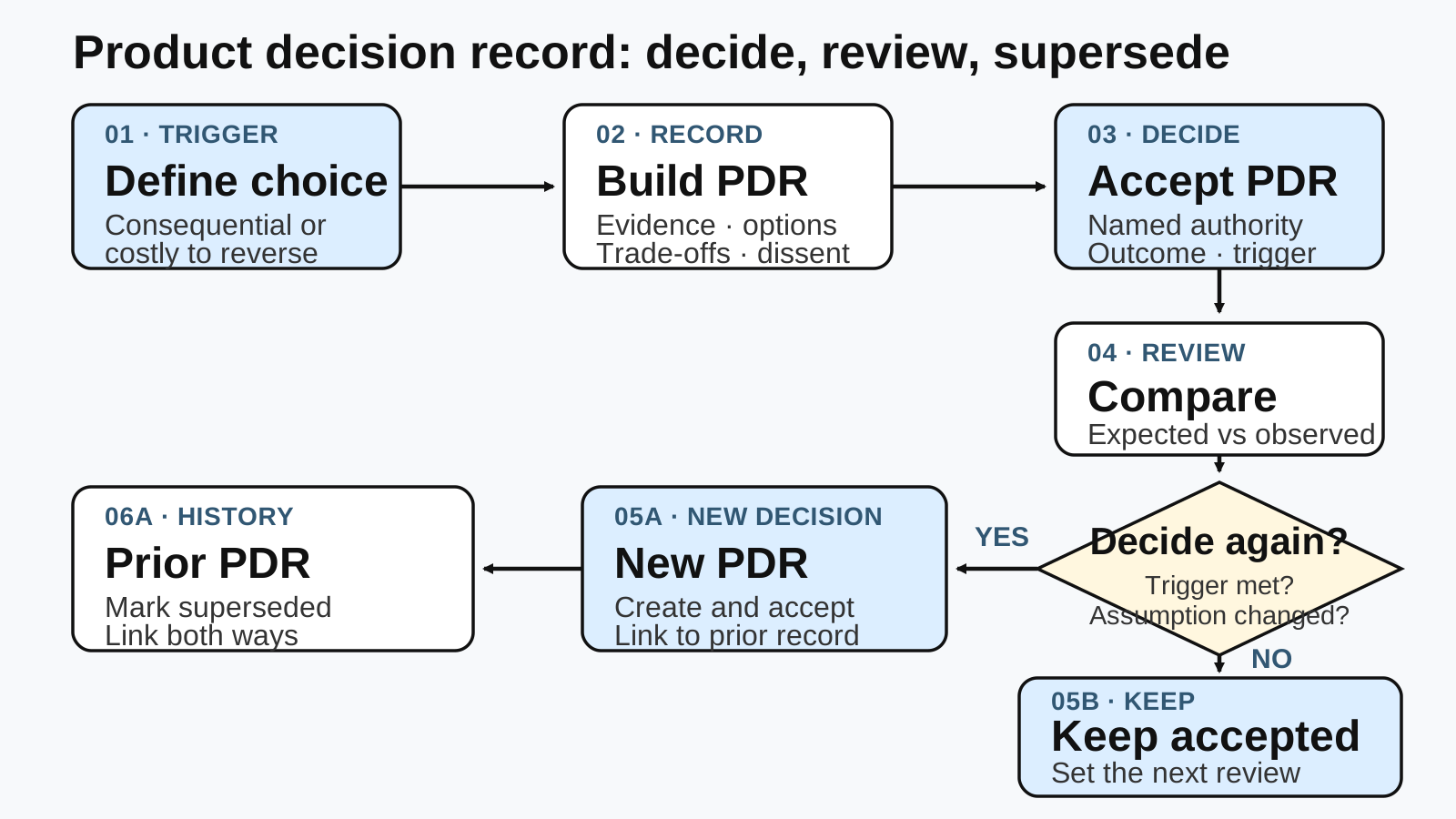
Now a future sales leader can challenge the assumptions instead of restarting the argument. If the trigger is met, the old record is not edited to make history look tidy. The steward opens a new proposed PDR, the authority decides again, and an accepted replacement links back while marking the old record superseded. AWS recommends this immutable-and-superseded lifecycle for accepted ADRs, and the principle works equally well here.
The workflow matters more than the template
1. Name the authority and the steward
The steward is not required to produce every analysis or possess every decision right. The steward assembles evidence, identifies reviewers, records the authority's decision, and schedules review. The authority owns the call and its accepted consequences. Six approvers and no named authority is usually a discussion wearing formal clothes.
2. Invite consequences, not votes
Ask each function to explain consequences in its domain. Users may face workflow friction. Sales may face a longer cycle. Engineering may create a permanent branch. Finance may see margin dilution. Support may need a new coverage model. Product integrates these consequences; it should not average them into a popularity score.
3. Compare genuine options
Each option should be feasible, mutually understandable, and described fairly. If one column says ‘strategic platform’ and another says ‘keep old bad system,’ the decision was made before the table was opened. Use a relevant prioritization method from the customer-needs prioritization frameworks only when its inputs match the question. A score is not evidence merely because it has decimals.
4. Record dissent
Consensus is useful but not mandatory. A short dissent note can preserve a risk that the majority discounts. Record the concern, its evidence, and the condition under which it becomes important. Do not turn the PDR into a transcript.
5. Review outcomes without rewriting history
At the review date, compare expected and observed outcomes. Keep the accepted decision and rationale intact. Attach a dated review note. If the authority changes the decision, create a new PDR and link both records. This makes the log useful for learning: teams can see whether the evidence was weak, an assumption changed, execution failed, or the decision was sound despite an unfavorable result.
This traceability also supports risk-sensitive work. Task PW.1.2 in the NIST Secure Software Development Framework calls for tracking software security requirements, risks, and design decisions. A product record should link to—not duplicate—specialist technical, security, legal, or compliance evidence.
Make the product decision log discoverable
A correct record that nobody can find has failed its operating purpose. Keep accepted PDRs in one searchable index close to the team's work. Give each record a stable ID and durable path. Store the record in version control or another system that preserves who changed what and when. GDS recommends version-controlled architecture decisions for the same reason.
The index should show title, status, authority, steward, decision date, review date, and supersession links. Proposed records may change during review. Once accepted or rejected, preserve the decision and rationale; add dated review notes or superseding records instead of silently rewriting history. Link outward to research, forecasts, requirements, contracts, risks, and implementation work rather than copying specialist evidence into a document that will drift.
Five ways decision logs stop helping
- Recording everything. Volume hides the consequential decisions and creates documentation fatigue.
- Writing after the fact. A polished rationale produced after leadership has chosen is communication, not a decision record.
- Using only supporting evidence. Excluding contradictory evidence makes the document persuasive but unreliable.
- Leaving authority or assumptions implicit. Nobody knows who can close the choice or when changed conditions justify a new one.
- Never reviewing outcomes. The team creates an archive, not a learning system.
A PDR will not make an uncertain decision certain. It will make the uncertainty and accountability visible. That is already progress.
The minimum useful record before the next consequential decision
- Is the choice consequential enough to record?
- Can a new team member understand the trigger, context, and constraints?
- Are decision authority and record stewardship named separately?
- Are observations separated from interpretations and linked to source evidence?
- Are at least two credible options, including the status quo, represented fairly?
- Are user, business, technical, and operational consequences included?
- Are assumptions and the expected outcome explicit?
- Is the reversal trigger operational, time-bounded, and assigned?
- Are status, review date, and supersession links present?
- Can somebody outside the original meeting find the current record?
The best decision record does not say, ‘We were right.’ It says, ‘Given what we knew, this was our judgment—and here is the evidence that will make us decide again.’
Make the next product decision easier to revisit

Copy the template for one consequential choice this week. Name the authority, preserve the evidence, and give future information an explicit route to change the answer.