

The product worked in the demo. That does not mean the organization can launch it. Support may have no escalation path, sales may promise an unverified outcome, security may still have an open high-risk finding, and nobody may know how to reverse the rollout.
A useful launch-readiness scorecard evaluates customer value, product quality, security, delivery, operations, commercial readiness, customer enablement, and measurement. It also keeps hard blockers outside the average. A strong marketing plan cannot compensate for an unacceptable safety risk.
Launch readiness is more than a completed feature list
Most launch checklists contain many legitimate tasks: finish the landing page, train sales, prepare support articles, confirm analytics, schedule announcements. The problem appears when completion is mistaken for readiness.
A task can be complete while its outcome remains weak. Sales training may be delivered, but the team may still be unable to explain which customer should not buy the product. Testing may be complete, but the unresolved defects may affect the primary workflow. Documentation may exist, but support may not know who owns an escalation.
Aha!’s launch guidance frames a launch plan as cross-functional work spanning product, go-to-market, systems, sales, support, and feedback. That breadth is necessary. A scorecard adds a harder question: what evidence shows that each area is ready enough for this launch?
The answer depends on launch type. A private design-partner release, a public SaaS feature, a medical workflow, and a physical product entering production should not share identical thresholds. The framework stays stable; the evidence and gates change.
The eight dimensions, weights, and hard gates below are a Data Panda starting framework, not a universal launch formula. Adapt them to the product’s risk and the defined launch scope.
Start by defining what ‘launch’ means
Teams often debate go/no-go while imagining different events. Marketing imagines an announcement. Engineering imagines production deployment. Sales imagines permission to quote. Operations imagines the first customer incident. Finance imagines revenue recognition. The customer imagines a working outcome.
Write one launch statement:
On [date or window], [specific customer group] can [buy/access/activate] [defined scope] in [markets or environments], supported by [delivery and service model], with [explicit limitations].
This forces boundaries into the decision. If the launch is a controlled pilot for five named accounts, the support model can be manual and high-touch. If it is self-service and public, the same model is not ready.
Scope discipline also connects to the MVP concept. A smaller release can be valid when it delivers a coherent outcome and produces learning. It is not valid when the team relabels missing safety, security, or operability as ‘minimum.’
The eight-part readiness scorecard
Score each dimension from 0 to 4 using evidence:
- 0 — unknown: no owner or credible evidence.
- 1 — weak: major gaps; readiness depends on hope or untested assumptions.
- 2 — conditional: meaningful evidence exists, with material gaps and owned mitigation.
- 3 — ready: evidence meets the defined launch threshold; minor debt is accepted.
- 4 — strong: threshold is met with margin, contingency, and clear ownership.
Convert each rating to its share of the weight: rating divided by four, multiplied by the weight. The mathematics organizes the conversation. It does not make the judgment objective.
| Dimension | Weight | Evidence for a ready rating |
|---|---|---|
| Customer value and scope | 20 | Target customer, problem, primary journey, claims, limitations, and success outcome are validated for the launch cohort. |
| Quality, reliability, and safety | 20 | Acceptance evidence exists; defects are classified; reliability and safety risks have owners and disposition. |
| Security, privacy, and compliance | 15 | Applicable requirements, threat and privacy risks, approvals, residual risks, and response responsibilities are documented. |
| Delivery, migration, and rollback | 10 | Release path is rehearsed; data or customer migration is understood; containment or rollback is feasible. |
| Operations and support | 10 | Monitoring, runbooks, support coverage, escalation, service ownership, and supplier responsibilities are active. |
| Commercial and go-to-market | 10 | Positioning, price, packaging, contract terms, channels, forecast assumptions, and sales qualification are aligned. |
| Customer enablement | 10 | Onboarding, documentation, training, accessibility, implementation, and change-management needs are covered. |
| Measurement and governance | 5 | Baseline, leading signals, outcome metrics, decision owner, review cadence, and stop/expand rules are defined. |
The weights above are a starting point for products with meaningful operational and launch risk. A safety-critical physical product should move more weight—and more veto power—toward safety, manufacturing, and compliance. A low-risk internal feature may put more weight on user value and adoption. Record the weights before reviewing the scores; changing them afterward to pass the launch is spreadsheet choreography.
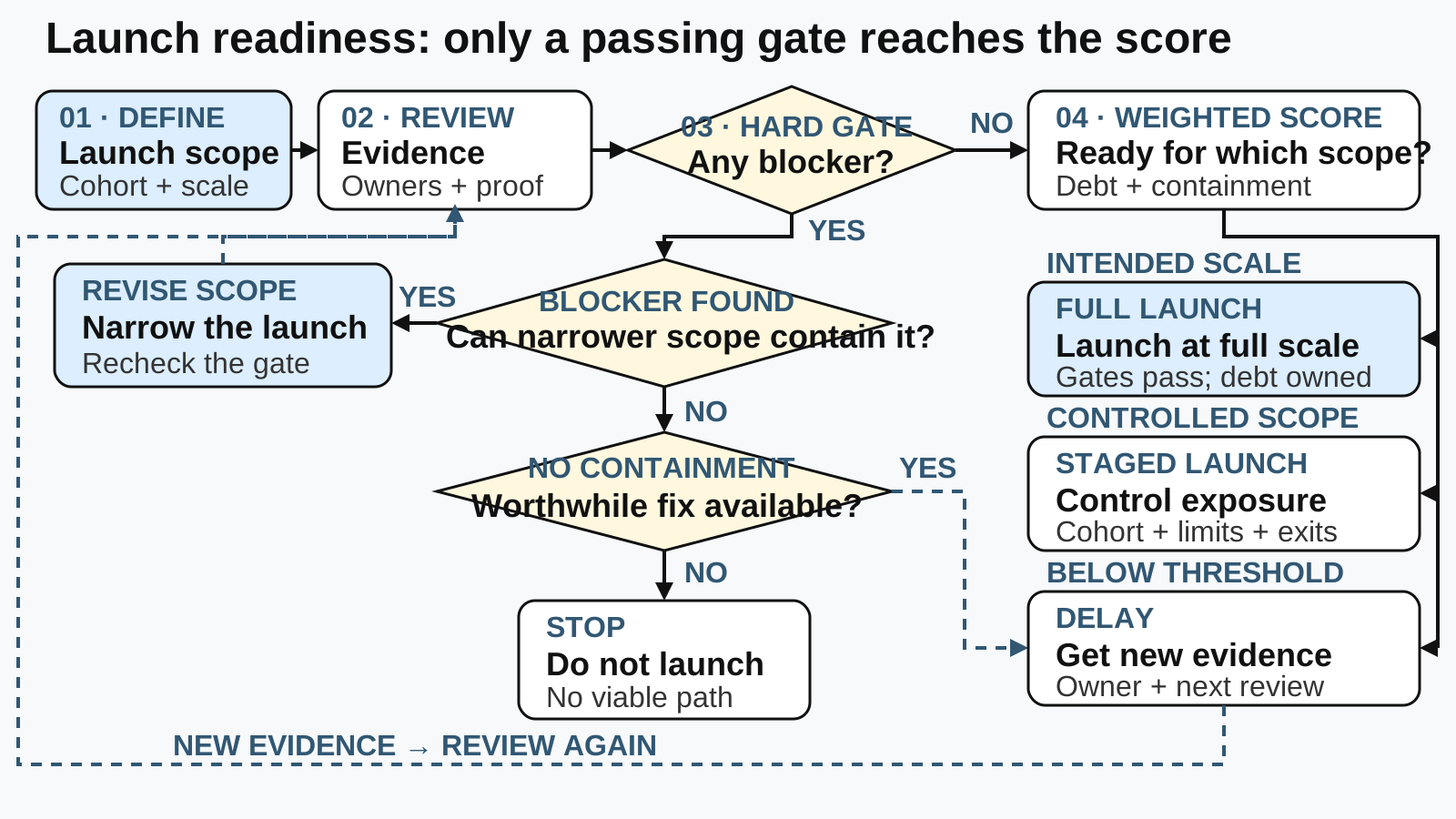
Hard gates stay outside the score
An average can hide a severe risk. Seven strong dimensions and one zero may still produce an attractive total. Therefore define hard gates before scoring.
Typical gates include:
- An unresolved safety, security, privacy, legal, or regulatory issue exceeds the organization’s accepted risk.
- The product cannot reliably complete the primary customer outcome for the launch cohort.
- A material failure cannot be detected, contained, rolled back, repaired, or communicated within an acceptable plan.
- No accountable owner exists for production operation, customer support, incident response, or required field service.
- Claims, contract terms, warranties, or sales commitments exceed available evidence.
- A critical supplier, manufacturing, deployment, or data-migration dependency is unverified.
A gate is not automatically permanent. It can change the launch shape. If broad release lacks a scalable support model, a small named-account launch with dedicated coverage may be safe. If a security control is mandatory for the target customers, changing the press-release date does not solve it.
The NIST Secure Software Development Framework is explicitly outcome-based and risk-based rather than a universal checklist. It includes preparing the organization, producing well-secured releases, protecting software, and responding to vulnerabilities. A product launch review should similarly ask whether the relevant outcomes exist, not whether somebody ticked a generic ‘security reviewed’ box.
One metro can still be too broad
The following case is hypothetical. A home-services marketplace plans its first public launch in one metropolitan area. A closed pilot has proved the core booking path for supported jobs: a customer can choose a service, request a time, receive a provider match, complete the appointment, and pay through the platform.
The happy path works. The marketplace around it is not yet ready at the same scale. A local marketing campaign creates a strong date, providers expect new demand, and the team initially treats launch as permission to open the booking flow across the metro.
The scorecard exposes a different product: verified providers, balanced local supply, recoverable payments, dispute handling, support coverage, and trust-and-safety operations.
The evidence review
- Customer value: 3/4. Customers in the pilot completed the primary booking journey, but the promise becomes weak when no suitable provider is available in the requested area or category.
- Quality, reliability, and safety: 2/4. Provider vetting and proof of active insurance are defined, but verification is not consistent across every provider and service category proposed for launch.
- Security and compliance: 3/4. Card data remains with the payment processor, access controls are reviewed, and the privacy scope is documented for the launch cohort. Residual debt has an owner.
- Delivery and rollback: 3/4. Geography, category, provider, and customer-cohort controls are rehearsed. Stopping new bookings is feasible, while already accepted jobs still require service and communication.
- Operations and support: 1/4. No single escalation path covers urgent complaints, provider no-shows, disputed work, refunds, or trust-and-safety events through every bookable hour.
- Commercial readiness: 3/4. Customer pricing, provider commission, promotions, and core terms are aligned; responsibility for disputed-service edge cases still needs clearer language.
- Customer enablement: 2/4. Provider onboarding covers accepting and completing a job, but cancellation, refusal, evidence capture, and dispute handling have not been tested end to end.
- Measurement: 2/4. The booking funnel is instrumented, but supply density, time to match, provider acceptance, cancellations, refunds, disputes, and safety signals are not yet tied to expand or pause rules.
The weighted score is 61.25 out of 100. More importantly, inconsistent provider verification and missing urgent escalation ownership trigger hard gates for a metro-wide launch. Weak supply density is not automatically a safety gate, but it can invalidate the primary promise if customers repeatedly cannot obtain the service they booked.
A staged launch must pass its own gates
The team compares four options:
- Open every announced category across the metro and accept the operational gaps.
- Delay every external activity until all eight dimensions reach 4.
- Launch a controlled cohort in a few adjacent postal zones and selected categories, using only providers whose vetting and insurance evidence is current.
- Stop the marketplace.
Option three is viable only after the narrower scope clears its own gates. Before accepting bookings, the team exercises payment capture, cancellation, refund, and dispute flows; names support and trust-and-safety owners for every bookable hour; verifies the selected provider pool; and reruns the hard-gate review.
The staged plan caps exposure, limits customer invitations, and defines expansion signals for available supply, successful matching, completed work, cancellations, refunds, disputes, and safety events. This is not permission to hide an unacceptable risk inside a smaller cohort. It is a different launch whose evidence can be evaluated honestly.
The decision becomes go for the narrowed launch only after those gates pass. The rest of the metro remains delayed until its provider coverage and operating model meet the same standard.
Use evidence, not confidence adjectives
Replace ‘engineering is comfortable’ with the test report, supported configuration list, and accepted defect disposition. Replace ‘sales is ready’ with qualification criteria, approved claims, pricing, contract terms, training assessment, and pipeline assumptions. Replace ‘support knows the product’ with an exercised runbook and named escalation owner.
Requirements also need evidence. The article on requirements-gathering mistakes explains why unclear and prematurely frozen requirements create downstream problems. At launch, each critical requirement should have an acceptance method and result, not merely a completed ticket.
The same is true for delivery. The software shipping cycle covers the path from planning through deployment. For a launch review, add real-world containment: feature flags, cohort controls, rollback, data repair, customer communication, spare parts, or field-update plans as applicable.
Four legitimate outcomes of a readiness review
Full launch
Hard gates pass, the score exceeds the agreed threshold, and residual debt has owners and dates. The organization can deliver the defined promise at the intended scale.
Staged launch
The product can create value safely within a controlled cohort, geography, configuration, or channel. Exposure and learning rules are explicit. Google’s SRE guidance defines a canary as a partial, time-limited deployment evaluated before continuing a rollout. The exact mechanism differs across software, marketplaces, services, and hardware, but the principle is useful: learn with controlled exposure.
Delay
A gate cannot be contained within a narrower launch, or the remaining evidence will materially change the decision. The delay should have a reason, owner, evidence plan, and next review date—not ‘until everyone feels ready.’
Stop
The evidence may show that the value, economics, feasibility, or risk no longer justifies launch. This outcome is painful but legitimate. Launch readiness is not a ceremony designed to approve sunk cost.
Run the review without turning it into theatre
- Set scope, gates, weights, and threshold early. Do this before the final week.
- Name one owner per dimension. Product integrates the decision but should not certify specialist evidence it does not own.
- Link every rating to evidence. Unknown is a valid score; hidden unknown is not.
- Review dissent and dependencies. A small unresolved interface can dominate a large program.
- Choose launch shape. Full, staged, delayed, and stopped are all available.
- Record accepted debt. Include consequence, owner, mitigation, due date, and trigger.
- Schedule post-launch decisions. Decide in advance when to expand, pause, roll back, or revise the promise.
Measurement should include leading and lagging signals. The existing guide to leading and lagging product indicators can help distinguish early adoption or reliability signals from later customer and commercial outcomes.
Twelve questions for the final launch review
- Is the launch scope written in one unambiguous statement?
- Are target customers and excluded configurations explicit?
- Does each dimension have an owner and linked evidence?
- Were gates, weights, and thresholds set before final scoring?
- Can the product complete the primary outcome reliably and safely?
- Are security, privacy, legal, compliance, and claims risks accepted by the right owners?
- Are deployment, migration, rollback, repair, and communication plans credible?
- Can operations and support serve the intended launch scale?
- Are price, packaging, contracts, positioning, and sales qualification aligned?
- Can customers onboard and succeed without hidden heroics?
- Are expand, pause, rollback, and stop rules defined?
- Is accepted debt documented with an owner and trigger?
A launch date creates urgency. It does not create readiness. Score the whole product system, protect the hard gates, and change the launch shape when the evidence demands it.
Score the launch system, not only the release

Define the launch scope, eight evidence dimensions, and non-negotiable gates before the final review. A narrower honest launch is stronger than a broad promise the organization cannot support.