

A pricing experiment and a physical design freeze can appear on the same product roadmap. They should not pass through the same decision process. One can be changed next week; the other may lock tooling, certification, inventory, and customer commitments together.
Product strategy under uncertainty means matching the evidence effort to the cost of being wrong, the cost of waiting, the reversibility of the choice, and how quickly reality will provide feedback. Cheap, reversible decisions should move with limited evidence and strong measurement. Expensive, sticky decisions deserve deeper evidence, alternatives, and explicit protection against failure.
Uncertainty is not permission to treat every decision equally
Product teams usually fail in one of two directions. Some demand certainty before acting, so reversible decisions wait for another analysis, another workshop, and a research sample large enough to impress everyone. Others use ‘we are learning’ to justify commitments that cannot realistically be undone.
Both approaches ignore decision shape.
A feature flag, a pilot workflow, a message, and a limited pricing test can often be reversed. A custom contract promise, public API removal, manufacturing tool, regulated claim, data architecture, or exclusive supplier agreement may create a long tail of consequences. The evidence threshold should rise with that tail.
Amazon’s 2015 shareholder letter made the useful distinction between consequential one-way-door decisions and reversible two-way-door decisions, arguing that reversible choices can use a lighter process. The original letter is available in Amazon’s public investor materials. The metaphor is valuable, but product managers need more than two doors. Reversibility is a spectrum, and some doors look reversible until contracts, customer data, training, or physical inventory stand in the doorway.
Separate knowable facts from residual uncertainty
Before choosing evidence, divide the unknowns into two groups:
- Knowable now: facts the team can obtain through appropriate work—technical feasibility, current customer workflow, supplier lead time, contract constraints, support volume, unit economics, or current competitor behavior.
- Residual uncertainty: what remains genuinely uncertain after reasonable analysis—future demand, competitor response, regulation not yet decided, adoption behavior, or performance of an immature technology.
McKinsey’s strategy-under-uncertainty framework similarly distinguishes a clear-enough future, a few alternative futures, a range of futures, and true ambiguity. Its durable lesson is not that every product needs four scenario decks. It is that analytical tools should match the uncertainty that remains after the knowable work is done.
If five customers use the current workflow differently, more financial precision will not remove demand uncertainty. If the team has not asked engineering whether a proposed integration is feasible, calling feasibility ‘uncertain’ is laziness with a nicer name.
The four-variable, five-shape model below is Data Panda’s synthesis, not a universal scoring formula.
The four variables that set the evidence budget
1. Reversibility
Ask what must happen to return to the previous state. Can the team switch off the change, migrate data back, notify a small cohort, or end a pilot? Or would reversal require scrapping inventory, renegotiating contracts, recertifying a product, retraining customers, or rebuilding trust?
2. Cost of being wrong
Estimate the credible downside across customers, business, technology, and operations. Include opportunity cost and second-order effects. A weak onboarding test may reduce conversion for one cohort. A weak identity architecture may block enterprise adoption and create security exposure.
3. Cost of delay
Waiting also makes a decision. A delayed fix may extend customer harm. A delayed market test may surrender a learning window. A delayed supplier commitment may miss capacity. Evidence has value only if it arrives before the decision loses relevance.
4. Learning latency
How soon after acting can the team detect whether the choice works? Interface behavior may produce feedback within days. Renewal, reliability, physical degradation, channel performance, and organizational change may take much longer. Slow feedback increases the value of pre-commitment evidence and protective design.
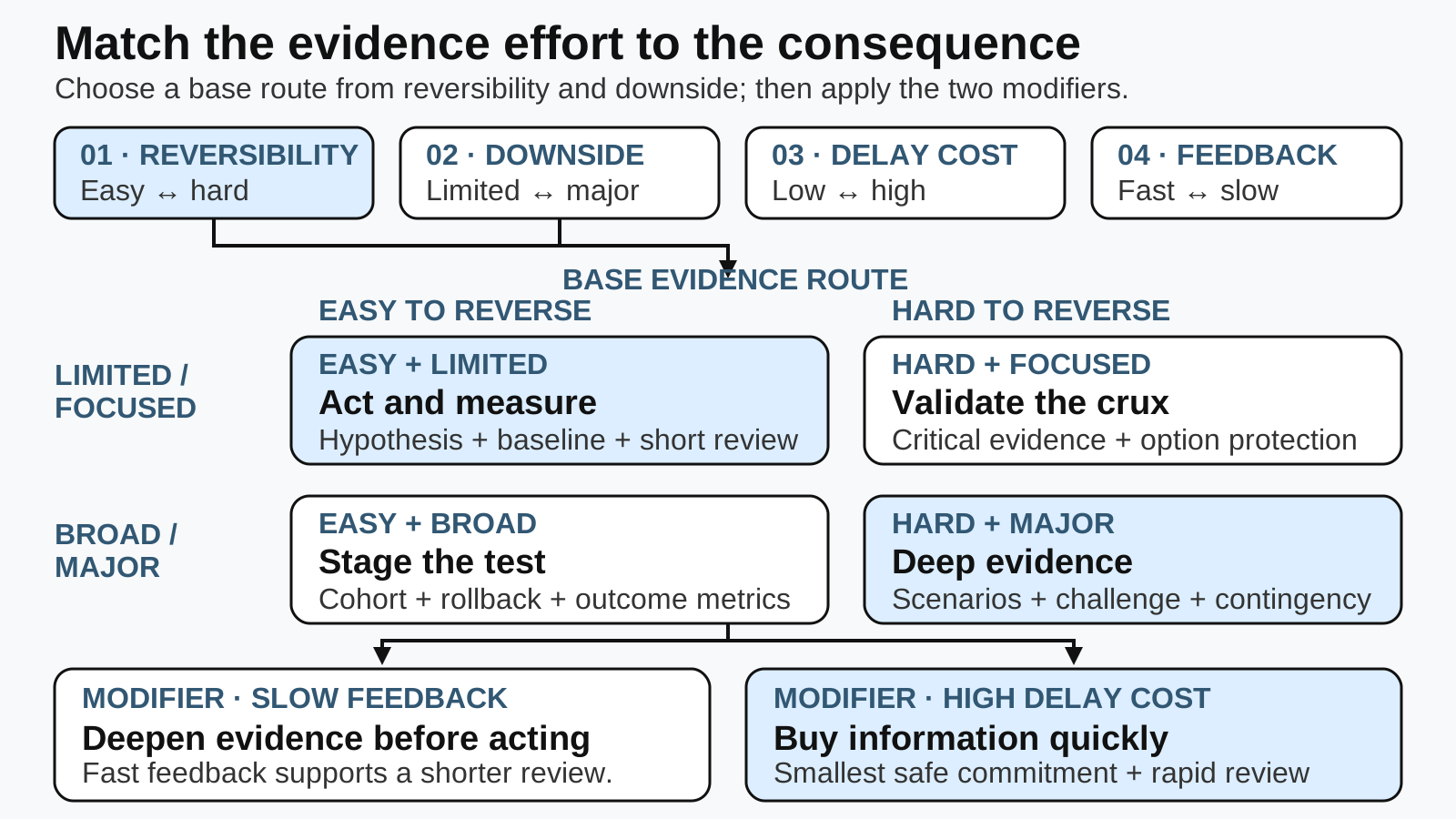
A decision table for evidence depth
| Decision shape | Default approach | Minimum evidence | Protection after action |
|---|---|---|---|
| Easy to reverse, limited downside | Act and measure | Clear hypothesis, basic feasibility, baseline | Instrumentation and short review window |
| Easy to reverse, broad customer exposure | Stage the decision | User evidence, risk review, expected metric movement | Cohort, feature flag, rollback rule |
| Hard to reverse, narrow downside | Validate the critical assumption | Alternatives, technical and commercial evidence | Option-preserving design and milestone gates |
| Hard to reverse, major downside | Deep evidence and senior judgment | Cross-functional evidence, scenarios, independent challenge | Contingency, contractual protection, explicit stop trigger |
| High cost of delay | Buy information quickly | Evidence focused on the largest uncertainty | Smallest safe commitment and rapid review |
This is not a scoring formula. A score can create false precision when inputs are judgments. Use the table to expose why one decision needs a week and another needs a quarter, then make the reasoning durable. The product-management thinking example shows why operational and commercial perspectives belong in the same decision.
A paywall experiment and an entitlement migration are not peers
The following case is hypothetical. A consumer subscription app has customers who joined at different times through web checkout and mobile app stores. The company wants to introduce family plans, but years of account and subscription history sit behind the current single-person experience.
The roadmap contains two decisions:
- Test a shorter onboarding sequence and show the paywall after the user reaches an early value moment.
- Migrate legacy accounts, product entitlements, and app-store billing references into a unified entitlement service before family memberships depend on it.
Both affect subscription growth. Their reversal cost, downside, and learning speed are completely different.
The onboarding and paywall test is bounded
The team can place the new sequence behind an experiment assignment, limit it to eligible new users, preserve the current flow as a control, and stop exposure without rewriting existing accounts. It can define the hypothesis, baseline onboarding completion and early engagement, and watch trial starts, purchase completion, cancellations, support contacts, and signs that the paywall obscures rather than explains value.
The decision is reversible, but not consequence-free. A user who sees an offer or starts a subscription keeps that commercial history. Promotional eligibility, receipts, and expectations cannot simply be deleted when the experiment ends. That is why the right evidence shape is a staged test with explicit exclusions and a short review window, not an unmeasured switch for every new user.
This is a practical use of the MVP concept: reduce exposure while learning about the journey and offer. It is not permission to use misleading copy, create inconsistent purchase states, or call a broken checkout ‘minimum.’
The entitlement migration is a chain of commitments
The migration has a different shape. A family plan needs a trustworthy answer to several questions: which account owns the subscription, which people receive access, what happens after a refund or renewal failure, and how a customer restores a purchase on another device. App stores continue to control their payment credentials; the product is migrating account links, billing references, subscription state, and the entitlement derived from that state.
Many facts are knowable before migration. The team can inventory legacy identity patterns, duplicate and merged accounts, active and expired entitlement states, restore-purchase paths, refund and grace-period handling, and the rules that will connect a purchaser to family members. It can compare the legacy sources, find ambiguous ownership, and decide which system will become authoritative.
A credible plan might use read-only shadow comparisons, dry-run reconciliation, an idempotent per-account backfill, a migration ledger, and an exception queue for records that cannot be resolved safely. Small cohorts can move behind gates, with product access reconciled against billing state after each cohort. The repair path matters more than a theatrical promise that every write can be rolled back.
Residual uncertainty still remains. The team cannot know exactly how households will share invitations, which edge cases will drive support, or how family plans will affect retention before customers use them. But those unknowns do not excuse preventable entitlement errors. A mistaken paywall treatment may affect one bounded cohort; a mistaken migration can lock a paying customer out, grant access to the wrong account, or create family relationships that are difficult to unwind.
Feedback is also slower. Some defects appear only when a subscription renews, enters a grace state, is refunded, or must be restored. That latency raises the value of pre-commitment evidence, cohort gates, reconciliation, and explicit ownership for repair.
Account creation connects the two decisions
The paywall experiment and migration are not independent if the experiment changes when an account is created or which identity receives the purchase. Running both without a shared contract can create new legacy records while the team is trying to remove the old ambiguity.
The strategy changes: either the experiment writes through the new identity and entitlement rules, or the migrating cohorts are excluded until the contract is stable. Growth evidence still matters, but it cannot be interpreted cleanly if account creation, purchase ownership, and access are changing underneath the test.
This is why product strategy under uncertainty is a systems problem. A reversible interface choice can feed an irreversible data commitment. The product manager has to protect the boundary between them, not merely place both items on the same roadmap.
Choose evidence that can change the decision
Teams often collect evidence that is easy to produce rather than evidence that resolves the largest uncertainty. A broad attitudes survey may suggest interest in family plans, but it will not show whether a subscriber can recover a purchase after signing in on a new device. Ten usability sessions can reveal where people hesitate in onboarding; they cannot establish whether legacy billing states reconcile to the correct entitlements at renewal. A polished prototype can test comprehension of the offer, but it will not prove willingness to pay unless users face a real, clearly disclosed purchase decision.
For each critical uncertainty, write:
- What do we currently believe?
- Which decision depends on that belief?
- What observation would weaken or strengthen it?
- Which method can produce that observation in time?
- What is the smallest safe commitment while we learn?
A well-formed hypothesis makes the belief testable. The guide to qualitative versus quantitative data helps choose whether the next gap concerns mechanism, prevalence, behavior, or magnitude.
Preserve options without postponing every choice
Option value is not the same as indecision. A modular interface, short pilot, nonexclusive supplier, staged rollout, limited geography, or reversible commercial term can reduce the cost of learning. But optionality also has a price: more components, slower execution, weaker economies of scale, or a confusing offer.
Ask three questions:
- Which uncertainty is the option protecting us from?
- How much does that protection cost now?
- What milestone will cause us to exercise or abandon the option?
If the team cannot name the milestone, ‘keeping options open’ may simply mean avoiding commitment.
What should change the strategy?
Before deciding, specify signals that would change the path. These may include a technical test failure, a regulatory outcome, a design-partner commitment, a support-cost threshold, a competitor move, or evidence that the assumed user behavior does not occur.
The NIST Risk Management Framework describes risk management as a repeatable lifecycle rather than a one-time approval. Product strategy benefits from the same principle: decisions should have owners, monitoring, and reassessment as evidence changes. This is an analogy, not a claim that every product decision requires formal NIST governance.
Define the signal, the owner watching it, and the decision it reopens. Otherwise ‘we will remain flexible’ is just a pleasant sentence.
Before commitment: eleven evidence-budget questions
- What exact decision is required now?
- Which facts are knowable before acting?
- What residual uncertainty will remain?
- How reversible is the choice in practice, including contracts, data, operations, and trust?
- What is the credible cost of being wrong?
- What is the cost of delaying?
- How quickly will feedback arrive?
- Which evidence can actually change the choice?
- What is the smallest safe commitment?
- Which option or contingency is worth preserving?
- What signal, owner, and date will trigger review?
The goal is not certainty. The goal is to avoid spending three months proving a reversible choice while making an irreversible commitment on enthusiasm. Match the evidence to the consequence. Then decide.
Put the next roadmap decision through the four-variable test

Write down reversibility, downside, delay cost, and learning latency. The pattern will tell you whether to act, stage, validate, or protect the decision.